
What's Happening?
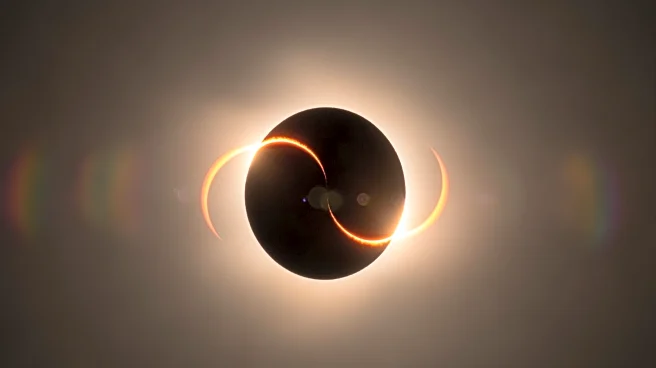
NASA has announced that the first solar eclipse of 2026 will occur on February 17, featuring an annular eclipse known as the 'Ring of Fire.' During this event, the Moon will pass directly in front of the Sun
but will not completely cover it, resulting in a bright ring of sunlight visible around the Moon. This phenomenon occurs when the Moon is at or near its farthest point from Earth, making it appear smaller than the Sun. The eclipse will begin with a partial phase at 9:56 am UTC and reach its peak at 12:12 pm UTC, lasting for over two hours. While the full annular eclipse will be visible from a remote part of Antarctica, partial views will be available in parts of southern Africa and the southern tip of South America. Unfortunately, the eclipse will not be visible from India, but enthusiasts can follow the event online.
Why It's Important?
The 2026 annular solar eclipse is significant for both scientific and public interest reasons. It provides astronomers and researchers with a unique opportunity to study the Sun's corona and other solar phenomena. For the general public, such celestial events spark widespread interest and engagement with astronomy, often leading to educational opportunities and increased public awareness of space science. The 'Ring of Fire' is a visually striking event that captivates audiences worldwide, fostering a sense of global connection as people from different regions tune in to witness the spectacle. Additionally, the event highlights the importance of international collaboration in space observation and research.
What's Next?
As the date of the eclipse approaches, space agencies and observatories around the world are expected to prepare for extensive coverage and live streaming of the event. This will allow people in regions where the eclipse is not visible to experience it virtually. Educational institutions and science centers may organize events and workshops to engage the public and provide information about the science behind solar eclipses. Furthermore, researchers will likely plan studies to take advantage of the unique observational opportunities presented by the eclipse, potentially leading to new insights into solar dynamics.