





What's Happening?
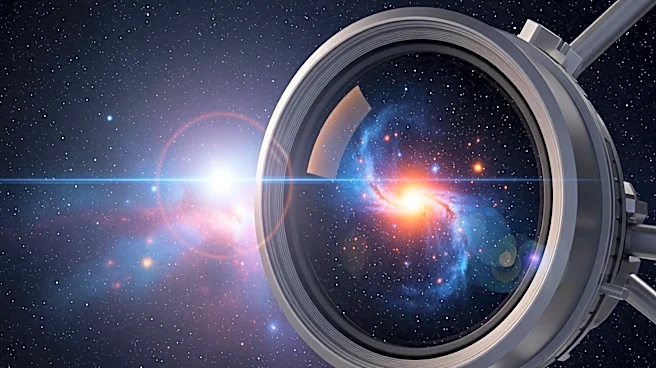
Astronomers using the James Webb Space Telescope (JWST) have discovered pairs of 'rogue' Jupiter-like objects in a stellar nursery, suggesting the existence of a new kind of celestial object. These objects, known as Jupiter-mass binary objects or 'JuMBOs',
are not gravitationally bound to any star and are found in a different part of the Milky Way than previously observed. The discovery challenges conventional theories of planet formation, as these binary pairs of planet-like objects measure between 0.7 to 30 times Jupiter's mass. The findings were made by a team led by Dante Minniti, a professor of astrophysics, who analyzed data from the Lower Centaurus-Crux association, a region with young, massive stars.
Why It's Important?
The discovery of JuMBOs could significantly impact our understanding of planet formation and the dynamics of celestial bodies in the universe. These findings suggest that free-floating planetary-mass binaries are rare, accounting for just 2% of rogue planets in the studied region. The existence of such objects could imply that planets can form and exist independently of stars, potentially altering the search for habitable worlds. The research also opens up new avenues for studying the conditions under which planets can retain liquid water and possibly support life, even without a star.
What's Next?
Further observations are planned using instruments like the European Southern Observatory's Very Large Telescope to better characterize these low-mass binary objects. The research team aims to confirm the existence of JuMBOs and explore their potential to support life. This ongoing research could lead to a deeper understanding of the formation and evolution of planetary systems in the galaxy.