
What's Happening?
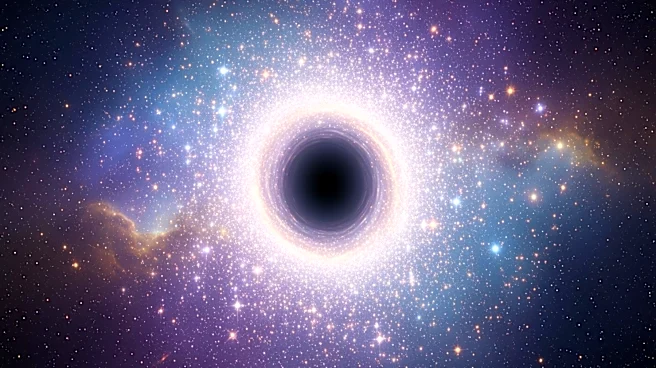
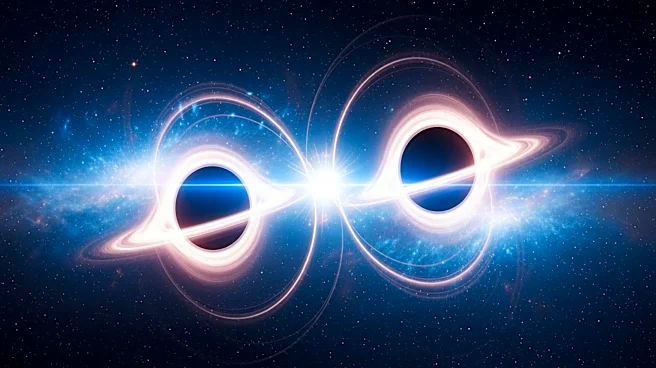
A recent study has revealed that the universe's largest black holes may form through repeated mergers in dense star clusters. Researchers analyzed gravitational waves from 153 black hole mergers, recorded
in the LIGO-Virgo-KAGRA Gravitational-Wave Transient Catalog. The study identified two distinct populations of black holes: a lower-mass group formed from collapsing stars and a higher-mass group with rapid, random spins, likely resulting from multiple mergers. This research supports the theory that dense star clusters are breeding grounds for massive black holes.
Why It's Important?
The findings provide new insights into the formation and evolution of black holes, challenging existing models of stellar evolution. By understanding the conditions that lead to the creation of massive black holes, scientists can refine their theories about the life cycles of stars and the dynamics of star clusters. This research also highlights the importance of gravitational-wave astronomy in uncovering the universe's hidden processes, offering a new perspective on cosmic evolution.
What's Next?
Researchers aim to further investigate the origins of massive black holes and the role of star clusters in their formation. Future studies will focus on refining models of stellar evolution and exploring the implications of these findings for our understanding of the universe. The continued use of gravitational-wave detectors will be essential in uncovering more about the mysterious processes that govern black hole formation.