



What's Happening?
A total lunar eclipse is set to occur on March 3, 2026, offering a spectacular celestial event for skywatchers. The eclipse will begin with the penumbral phase at 3:44 a.m., followed by the partial eclipse at 4:50 a.m., and the full eclipse starting at 6:04
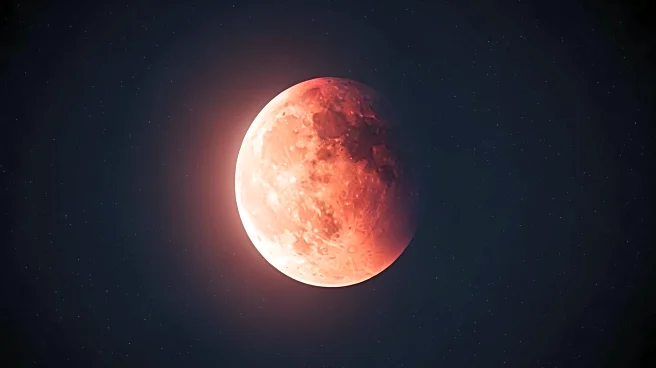
a.m. The maximum eclipse, when the moon is fully covered by Earth's umbra, will occur at 6:33 a.m. The event will conclude with the full eclipse ending at 7:02 a.m., and the penumbral phase wrapping up by 9:23 a.m. During a total lunar eclipse, the moon takes on a deep red or coppery hue, often referred to as a 'blood moon,' due to the Earth's shadow.
Why It's Important?
Total lunar eclipses are significant astronomical events that provide opportunities for scientific observation and public engagement. The phenomenon of the 'blood moon' captivates the public's imagination and can inspire interest in astronomy and space science. For researchers, lunar eclipses offer a chance to study the Earth's atmosphere and the effects of its shadow on the moon. The widespread visibility of the eclipse means that millions of people can experience this natural wonder, fostering a sense of global connection through shared observation.
What's Next?
As the date of the eclipse approaches, astronomers and educators will likely organize viewing events and educational programs to maximize public engagement. These events can serve as platforms for teaching about lunar cycles, eclipses, and the broader workings of the solar system. The eclipse may also prompt discussions about the cultural and historical significance of lunar events, as well as their scientific implications. Observatories and space agencies may use the opportunity to conduct research and gather data on the Earth's atmosphere and lunar surface.