



What's Happening?
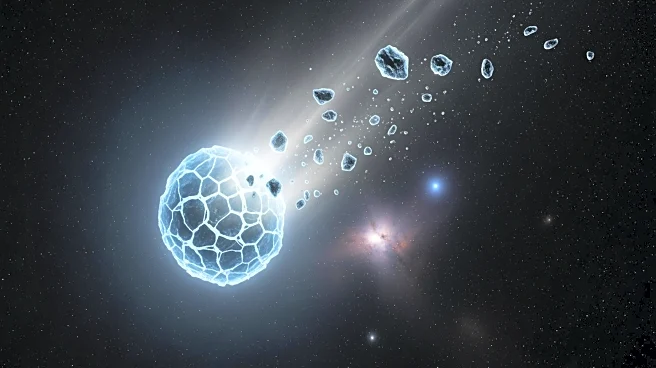
Astronomers are continuing their search for remnants of the comet C/2019 Y4 ATLAS, which broke apart in 2020. Initially discovered in December 2019, the comet was expected to be visible to the naked eye as it approached the sun. However, it disintegrated
into numerous fragments before reaching its closest point to Earth. A team led by Salvatore A. Cordova Quijano from Boston University has been investigating whether any substantial pieces of the comet remain. Their research, published in The Astronomical Journal, suggests that a fragment less than half a kilometer wide might still be orbiting the sun. Despite using advanced telescopes like the Lowell Discovery Telescope and the Zwicky Transient Facility, the team has not yet confirmed the presence of any remaining fragments. The study provides insights into the behavior of comets as they approach the sun and the potential for surviving fragments.
Why It's Important?
The investigation into C/2019 Y4's remnants is significant for understanding cometary behavior and the dynamics of celestial bodies in the solar system. Comets like C/2019 Y4 offer a rare opportunity to study the processes that occur when these icy bodies approach the sun and disintegrate. The findings could enhance our knowledge of cometary structures and their potential to survive solar encounters. This research also contributes to broader astronomical studies by providing data on the lifecycle of comets and their potential impact on the solar system. Understanding these processes is crucial for predicting future cometary behavior and assessing any potential threats to Earth from similar celestial events.
What's Next?
Future research will likely focus on improving observational techniques to detect smaller comet fragments. Astronomers may conduct more targeted searches following solar conjunctions, when comets re-emerge from behind the sun, to confirm the presence of surviving fragments. These efforts could lead to a better understanding of cometary disintegration and the conditions that allow fragments to persist. Additionally, the study highlights the need for continuous monitoring of comets as they approach the inner solar system, which could provide valuable data for predicting and mitigating potential impacts on Earth.