
What's Happening?
The 'Star of Bethlehem,' a celestial phenomenon mentioned in the Gospel of Matthew, has intrigued scholars and astronomers for centuries. The biblical account describes a bright star that guided the Magi
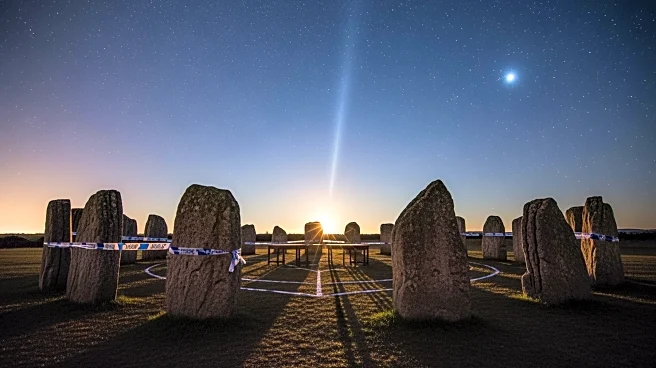
to Bethlehem, signaling the birth of a new 'king of the Jews.' Modern astronomy has yet to provide a definitive explanation for this event. As Jupiter becomes prominent in the night sky, some liken it to a 'Christmas Star,' though astronomers caution that this does not fully explain the biblical event. Historical records and astronomical reconstructions suggest possibilities such as rare planetary conjunctions, supernovae, or comets. Notably, a comet recorded by Chinese astronomers in 5 BC is considered a potential candidate. Despite various theories, the true nature of the 'Star of Bethlehem' remains unresolved, continuing to captivate both scientific and religious communities.
Why It's Important?
The enduring mystery of the 'Star of Bethlehem' highlights the intersection of science, history, and religion. For astronomers, it represents a challenge to understand historical celestial events using modern technology and knowledge. Theories about the star involve significant astronomical phenomena, such as planetary conjunctions and comets, which have implications for understanding ancient observations and their interpretations. For religious communities, the star holds symbolic significance, representing divine intervention and guidance. The ongoing debate and research into this phenomenon underscore the broader human quest to reconcile scientific inquiry with historical and religious narratives. This pursuit not only enriches our understanding of the past but also inspires contemporary discussions about the role of celestial events in cultural and religious contexts.
What's Next?
As Jupiter reaches opposition in January 2026, it will provide an opportunity for skywatchers to observe a bright celestial body reminiscent of the 'Christmas Star.' While this event is not expected to resolve the mystery of the 'Star of Bethlehem,' it may renew interest in astronomical phenomena and their historical interpretations. Researchers may continue to explore ancient records and employ advanced astronomical modeling to seek answers. The Vatican Observatory and other institutions may also engage in discussions about the star's significance, blending scientific inquiry with theological reflection. This ongoing exploration may lead to new insights or theories, keeping the mystery alive for future generations.
Beyond the Headlines
The fascination with the 'Star of Bethlehem' extends beyond its historical and scientific aspects, touching on ethical and cultural dimensions. It raises questions about the interpretation of religious texts in light of scientific discoveries and the role of celestial events in shaping cultural narratives. The star's story exemplifies how ancient observations can influence religious beliefs and traditions, highlighting the importance of interdisciplinary approaches in understanding historical phenomena. Additionally, the star's enduring mystery serves as a reminder of the limitations of human knowledge and the potential for future discoveries to reshape our understanding of the past.