



What's Happening?
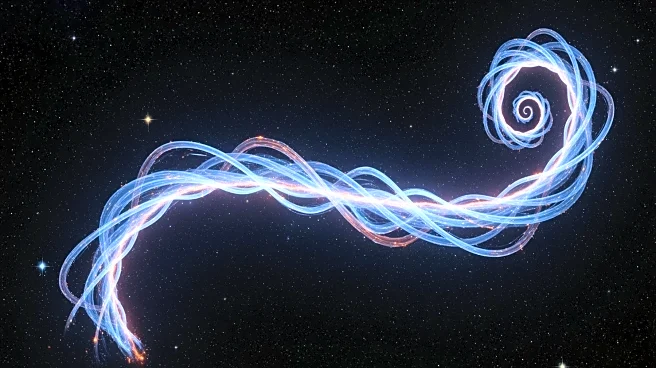
Astronomers have identified a massive cosmic filament, part of the universe's large-scale structure, spinning and influencing the motion of 14 galaxies. This discovery was made using data from South Africa’s MeerKAT radio telescope, along with observations
from the Dark Energy Spectroscopic Instrument (DESI) and Sloan Digital Sky Survey (SDSS). The filament, located approximately 424 million light-years away, is the largest known spinning structure, measuring around 117,000 light-years across and 5.5 million light-years long. The galaxies within this filament are moving at 250,000 miles per hour, suggesting a synchronized rotation influenced by gravitational interactions with the filament. This phenomenon provides insights into galaxy formation and evolution, as the transfer of angular momentum from the filament to the galaxies is a key factor in their development.
Why It's Important?
The discovery of this spinning cosmic filament is significant for understanding galaxy formation and the distribution of matter in the universe. The alignment of galaxies within the filament challenges previous assumptions about random galaxy orientation and could impact weak lensing observations, which are used to study dark matter distribution and the universe's expansion. By understanding these alignments, astronomers can refine their models and improve the accuracy of cosmological studies. Additionally, the filament's role as a 'live demo' of galaxy growth processes offers valuable data for future research, potentially leading to new insights into the cosmic web's structure and its influence on galaxy dynamics.
What's Next?
Researchers plan to search for more spinning structures using upcoming data from radio and optical telescopes, such as the Vera Rubin Observatory and the Euclid mission. These efforts aim to identify additional filaments and better understand their role in the cosmic web. By expanding the dataset, scientists hope to describe these structures more accurately and assess their impact on weak lensing observations. This research will also help prepare astronomers for analyzing data from future surveys, enhancing their ability to probe the universe's large-scale structure and the distribution of dark matter.
Beyond the Headlines
The alignment of galaxies within cosmic filaments not only affects weak lensing observations but also serves as a cosmological probe in its own right. With over 40% of the universe's mass predicted to reside in filaments, understanding their dynamics is crucial for cosmology. The combination of weak lensing, spectroscopic, and neutral hydrogen surveys provides complementary datasets to explore the cosmic web. This research highlights the importance of accounting for filament alignments in cosmological models, ensuring more precise predictions and analyses of the universe's structure.