
What's Happening?
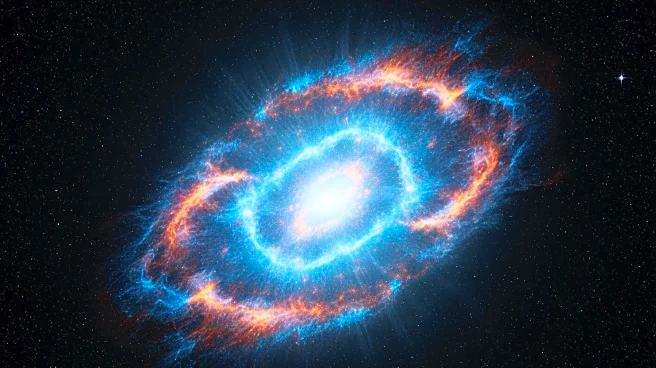
NASA has released a timelapse video showcasing 25 years of observations of Kepler's Supernova, also known as SN 1604. This supernova, first observed in 1604, is the remnant of a white dwarf star that exploded
in a Type Ia supernova. The video, presented by astronomers Jessye Gassel and Brian Williams at the American Astronomical Society meeting, highlights the rapid expansion of the supernova's ejecta. The remnant is located 20,000 light-years away, and its changes have been meticulously tracked using NASA's Chandra X-ray Observatory. The video provides a rare glimpse into the dynamic processes of a supernova remnant over a relatively short cosmic timespan.
Why It's Important?
The study of Kepler's Supernova is crucial for understanding the life cycle of stars and the distribution of elements in the universe. Type Ia supernovae, like Kepler's, are key to measuring cosmic distances due to their consistent brightness. The data from this timelapse can help refine models of supernova behavior and improve our understanding of cosmic history. Additionally, the elements dispersed by such explosions contribute to the formation of new stars and planets, making this research vital for comprehending the evolution of galaxies and the universe.
Beyond the Headlines
The visualization of Kepler's Supernova's expansion offers insights into the mechanics of stellar explosions and their aftermath. The study of such remnants can inform theories about the distribution of heavy elements, which are essential for planet formation and the emergence of life. Furthermore, the ability to track these changes over decades underscores the advancements in astronomical technology and observation techniques, highlighting the importance of continued investment in space research and exploration.