






What's Happening?
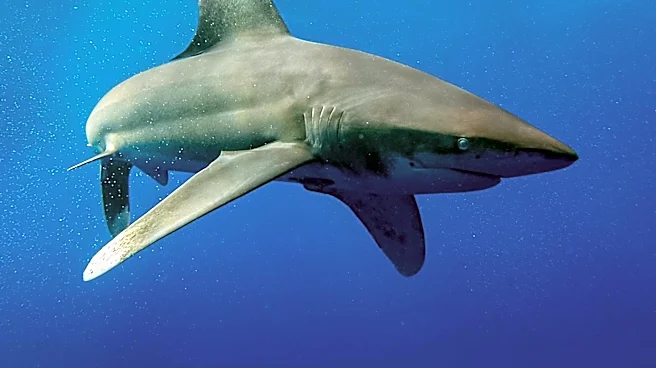
Researchers at Florida International University (FIU) have developed a novel technique to identify and track individual oceanic whitetip sharks, a critically endangered species. Published in Marine Biology, the study details how FIU marine biologists,
including Yannis Papastamatiou, used pelagic baited remote underwater video stations (pBRUVS) off Cat Island in The Bahamas. This method allowed them to identify over 50 individual sharks based solely on their unique fin patterns, which are as distinct as human fingerprints. While BRUVS are not new, the strategic deployment of pelagic BRUVS in deep waters where these sharks are relatively abundant marks a significant advancement. The primary goal of this research is to overcome the challenges of monitoring marine predator populations, which are far more difficult to track than terrestrial animals.
Why It's Important?
The ability to accurately track individual oceanic whitetip sharks is crucial for their conservation and management. Understanding whether populations are declining, stable, or increasing is fundamental for effective endangered species programs. The oceanic whitetip shark population in the Pacific has declined by an estimated 80-95% since the mid-1990s, and by approximately 88% in the Gulf of Mexico, primarily due to fishing. This new technique provides a non-invasive and effective way to gather vital data on these elusive marine predators. Improved monitoring can inform policy decisions regarding fishing quotas, protected areas, and other conservation strategies, potentially preventing further declines and aiding in the recovery of this and other endangered marine species. The success of this method could also be adapted for tracking other difficult-to-monitor marine life.
What's Next?
The FIU researchers plan to continue applying and refining this pBRUVS technique to gather more extensive data on oceanic whitetip shark populations. The long-term goal is to establish clearer trends in their numbers and distribution, which will be essential for assessing the effectiveness of current conservation efforts and developing new ones. This ongoing research will provide critical information to conservation organizations and governmental bodies responsible for marine wildlife protection. The insights gained could lead to more targeted and impactful interventions, such as stricter regulations on fishing practices that impact these sharks or the establishment of new marine protected areas. Further studies may also explore the application of this fin-pattern recognition technology to other shark species.
Beyond the Headlines
This research highlights a broader challenge in marine conservation: the difficulty of monitoring species in vast and opaque ocean environments. Unlike terrestrial animals that can be counted via aerial surveys, marine life often requires innovative technological solutions. The development of techniques like pBRUVS underscores a shift towards more sophisticated, less intrusive methods for ecological study. This approach not only provides crucial data but also minimizes disturbance to the animals. The success of this project could inspire similar technological advancements in marine biology, fostering a deeper understanding of ocean ecosystems and enhancing global efforts to protect biodiversity. It also emphasizes the critical role of academic institutions like FIU in pioneering conservation science.