






What's Happening?
Jasmine Dillon, Assistant Professor of Global Livestock Sustainability at Cornell University, is conducting research that emphasizes the integral role of animals in creating sustainable food systems. Her work, as reported by Jackie Swift, communications
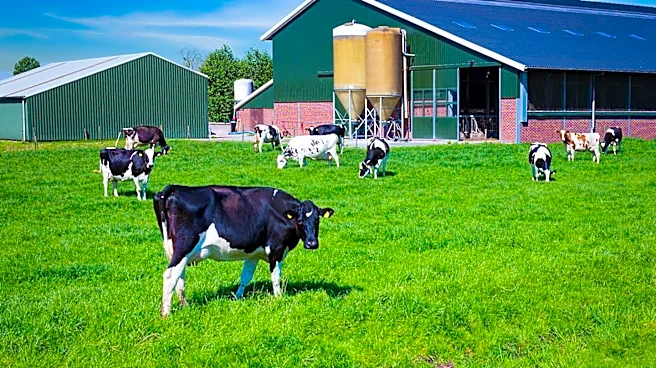
specialist for the Cornell CALS Department of Animal Science, uses an agroecological perspective to evaluate how farm management practices, policies, and sustainability measurements influence environmental outcomes. Dillon's research employs life cycle assessments to measure the environmental impacts of products like milk, meat, and corn, alongside process modeling to understand resource conversion into agricultural outputs. She views animals as crucial recyclers of energy and matter within ecosystems, forming part of a larger agricultural system. One of her projects, in collaboration with the Environmental Defense Fund, investigates whether improving smallholder dairy efficiency in India can reduce climate impacts, specifically focusing on enteric methane emissions from cattle digestion. This project also considers potential unintended consequences, such as increased herd sizes, which could offset emission reductions per unit of milk produced.
Why It's Important?
This research is important because it challenges a narrow view of livestock's environmental impact, advocating for a holistic understanding of agricultural systems. By highlighting animals as 'recyclers of energy and matter,' Dillon's work suggests that sustainable agriculture requires integrating livestock rather than isolating their impact. This perspective can inform U.S. agricultural policy and practices, promoting more integrated and resilient food systems. The investigation into the 'rebound effect' in dairy efficiency in India has significant implications for global sustainability efforts, including those in the U.S. If efficiency improvements lead to herd expansion and thus increased overall emissions, it underscores the need for strategic investment designs that prevent such unintended consequences. This insight is crucial for policymakers and agricultural stakeholders aiming to achieve both environmental protection and food security, ensuring that sustainability initiatives deliver genuine, long-term benefits without inadvertently exacerbating environmental challenges.
What's Next?
Dillon's ongoing research will continue to use mathematical modeling to connect agricultural research developments with broader questions of environmental sustainability and policy decisions. Her collaborative efforts with economists, soil scientists, and social scientists aim to deepen the understanding of relationships between agricultural production and natural resources. The City Food Policy Project, where Dillon is a co-principal investigator, will further examine purchasing decisions and the effectiveness of local food procurement policies. Future work will likely focus on developing strategies to mitigate the 'rebound effect' identified in the Indian dairy project, ensuring that efficiency gains translate into net environmental benefits. These findings could influence future agricultural investments and policy frameworks in the U.S. and internationally, guiding the design of sustainable agricultural systems that balance environmental protection with human well-being and food production.
Beyond the Headlines
The deeper implication of Dillon's research lies in its call for a paradigm shift in how agricultural sustainability is approached. Moving beyond a simplistic 'good vs. bad' narrative for livestock, her work emphasizes the complex interdependencies within agroecosystems. This perspective encourages a more nuanced public discourse and policy development, recognizing that solutions often require systemic changes rather than isolated interventions. Ethically, it prompts a re-evaluation of how efficiency improvements are implemented, ensuring they align with broader sustainability goals and do not inadvertently harm the environment or human well-being. Culturally, it could foster a greater appreciation for traditional agricultural practices that inherently integrate livestock into ecological cycles. Long-term, this research could contribute to the development of more resilient and environmentally sound food systems globally, influencing everything from consumer choices to international agricultural aid and investment strategies.