





What's Happening?
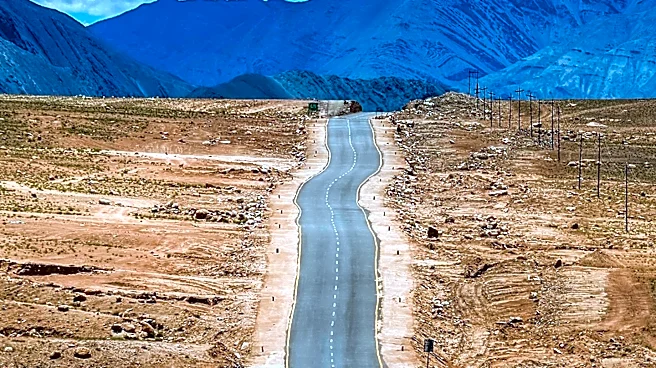
Afghanistan's Taliban government has inaugurated a newly constructed road linking the country to China's Xinjiang region through the strategically sensitive Wakhan Corridor. This development opens up new possibilities for regional connectivity and trade.
Abdul Latif Mansour, Afghanistan’s Minister of Rural Rehabilitation and Development, described the road as having "strategic, political and economic importance" for Afghanistan. The Taliban government reportedly spent over $5 million on the project. This initiative aligns with China’s efforts to strengthen its economic and security interests around Xinjiang, which borders eight countries, including Afghanistan, Pakistan, and India. The new link could create additional opportunities for cross-border trade and transit, and deepen Beijing's engagement with Afghanistan under Taliban rule.
Why It's Important?
This new road is significant for several reasons. For China, it provides another potential route for trade and transit with Afghanistan, diversifying its connectivity beyond existing links through Pakistan. It also addresses Beijing's long-standing concerns about militant groups operating from Afghanistan and threatening security in Xinjiang, as China has repeatedly urged the Taliban to act against groups like the East Turkestan Islamic Movement. For India, the road adds complexity to the regional landscape, as the Wakhan Corridor is near Gilgit-Baltistan, a territory claimed by India, and the wider Himalayan frontier where India and China have tensions. The development could affect regional trade dynamics and China's growing influence in South and Central Asia, potentially impacting India's efforts to deepen trade and energy links with Central Asia.
What's Next?
While the road has been inaugurated, it is currently an unpaved stretch of about 121 kilometers ending at the Chinese border. Its commercial viability and full operational status will depend on further development, including border arrangements, customs infrastructure, and security assurances from the Taliban, as well as China's willingness to open the crossing. The Taliban government is seeking closer economic engagement with Beijing, and China is pursuing relations with Kabul while prioritizing security and commercial interests. This development could also influence the future of China-Pakistan Economic Corridor (CPEC) projects, as a route through Afghanistan might offer China an alternative for regional connectivity, reducing its dependence on Pakistan for certain trade links, especially given security challenges faced by CPEC.
Beyond the Headlines
The construction of this road signifies a deeper geopolitical shift in Central and South Asia. It highlights China's pragmatic approach to engaging with the Taliban, prioritizing its economic and security interests despite international non-recognition of the regime. The project could lead to increased Chinese influence in Afghanistan, potentially altering regional power dynamics. Ethically, it raises questions about the implications of economic engagement with a regime known for its human rights record. The road's strategic location near disputed territories also has long-term security implications for India and the broader Himalayan region. This infrastructure development is not just about trade; it's about shaping future geopolitical alignments and access to resources in a volatile region.