



What's Happening?
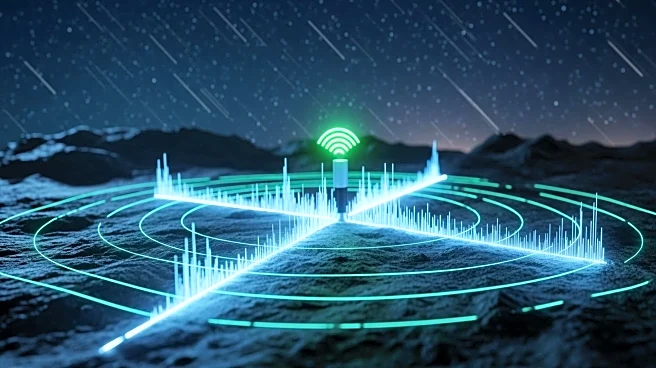
Researchers from Johns Hopkins University and Imperial College London have developed a method to track space debris using earthquake sensors. This innovative approach leverages the widespread availability of seismic sensors, which are traditionally used
to detect earthquakes, to monitor the sonic booms produced by re-entering space debris. The method aims to provide real-time information about the debris' trajectory and potential impact locations. This development comes in response to the challenges faced by current space traffic monitoring systems, which struggle to predict the exact re-entry paths of space debris due to chaotic atmospheric interactions. The new method was tested by tracking the re-entry of a module from China's Shenzhou 17 crew capsule, revealing discrepancies in predicted and actual trajectories.
Why It's Important?
The ability to accurately track space debris is crucial for mitigating potential hazards posed by falling fragments. With an average of three large pieces of space debris re-entering Earth's atmosphere daily, understanding their impact locations can help prevent environmental damage and protect populated areas. The new tracking method could significantly reduce the time needed to locate debris, allowing for quicker response and retrieval of potentially hazardous materials. This advancement is particularly important as the number of satellites and space missions increases, raising the likelihood of debris-related incidents. Improved tracking could also enhance safety for aviation and ground-based infrastructure.
What's Next?
Future studies aim to expand the method's reach by incorporating acoustic sensor networks, which can detect sonic booms over larger areas, including oceans where seismic data is sparse. This could provide a more comprehensive understanding of space debris re-entry patterns and improve global monitoring capabilities. Researchers hope to refine the method further to offer more precise predictions and enhance collaboration with international space agencies. The ongoing development of this technology may lead to new protocols for managing space debris and protecting both the environment and human populations from its potential impacts.