







What's Happening?
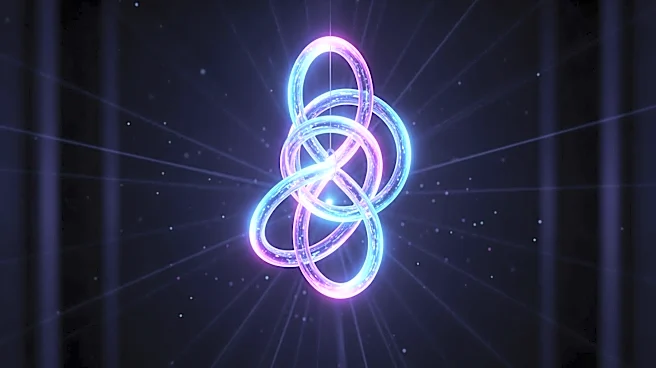
Researchers from several universities, including South China University of Technology and Uppsala University, have successfully observed isolated hopfions in a magnetic material using laser pulses. Hopfions are three-dimensional topological solitons characterized
by closed loops of swirling spin textures. These structures have been difficult to realize experimentally until now. The team used ultrafast laser pulses to create these hopfions, which were then observed using advanced electron microscopy techniques. This breakthrough opens new avenues for studying complex magnetic systems and could lead to the development of new magnetic memory devices and computing systems.
Why It's Important?
The successful observation of isolated hopfions marks a significant advancement in the field of topological magnetism. These structures are robust against perturbations, making them potential candidates for future information storage and processing technologies. The ability to control and manipulate hopfions could lead to innovations in spintronics, a field that explores the use of electron spin in electronic devices. This research not only answers long-standing questions about the existence and stability of hopfions but also provides a framework for further exploration of topological states in magnetic materials.
What's Next?
Future research will likely focus on exploring the practical applications of hopfions in technology. Researchers may investigate how to control and manipulate these structures more efficiently, potentially leading to new types of data storage and processing devices. Additionally, the study of light-matter interactions in magnetic systems could reveal new ways to use light to create and control topological states, further expanding the possibilities for advanced magnetic technologies.