



What's Happening?
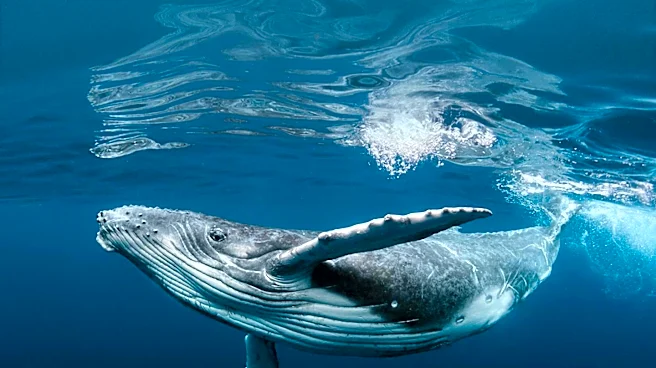
A humpback whale was observed in California's Sacramento River, approximately 60 miles from its typical Pacific Ocean habitat. Denny Glover, who was fishing for salmon and striped bass, first spotted the whale surfacing on Wednesday. Initially, he and his
companions mistook it for a dolphin or porpoise, but subsequent spouts confirmed it was a whale. The Marine Mammal Center reported that the whale entered San Francisco Bay earlier in the week and has been traveling eastward into the Sacramento-San Joaquin Delta, California's largest river delta. Scientists are now monitoring the whale's condition and trying to understand why it ventured so far inland. The whale is known to researchers through a photo identification catalog, having been documented 15 times over the past 24 years, with its most recent sighting before this event in Baja California in February.
Why It's Important?
The presence of a humpback whale so far inland in a major U.S. river system is a rare and significant event for marine biologists and environmental conservationists. It highlights the complex migratory patterns and occasional deviations of large marine mammals, prompting scientific inquiry into potential environmental factors or individual health issues that might lead to such an occurrence. This event also raises public awareness about marine life and the interconnectedness of ocean and freshwater ecosystems. For local communities, it presents both a unique wildlife viewing opportunity and a challenge to ensure the whale's safety and eventual return to its natural habitat without human interference. The Marine Mammal Center's involvement underscores the importance of specialized expertise in managing such unusual wildlife situations and educating the public on responsible interaction.
What's Next?
The Marine Mammal Center's cetacean team plans to assess and monitor the humpback whale's condition in the Sacramento River. The public is advised to avoid interacting with the whale or attempting to alter its course, as emphasized by Kathi George, the center's director of cetacean conservation biology. The primary goal is to allow the whale to either pass through naturally or to determine if there's an underlying ailment requiring intervention. Researchers will continue to observe its behavior and health, drawing on past experiences with similar incidents, such as the humpback whale 'Humphrey' in 1985 and the mother-calf pair 'Delta and Dawn' in 2007, both of whom eventually returned to the ocean. The California Department of Fish and Wildlife and the National Oceanic and Atmospheric Administration have declined to comment on the current sighting.
Beyond the Headlines
This unusual sighting of a humpback whale deep within a freshwater river system prompts broader questions about the impacts of human activity and environmental changes on marine life. While the immediate cause for this whale's inland journey is unknown, such events can sometimes be linked to factors like unusual prey distribution, disorientation due to noise pollution, or even the effects of climate change altering ocean currents and food sources. The incident serves as a natural experiment, offering scientists a unique opportunity to study whale physiology and behavior in an atypical environment. It also underscores the need for robust marine mammal protection policies and rapid response protocols for stranded or disoriented animals, ensuring their welfare and the ecological balance of both marine and freshwater habitats.