
What's Happening?
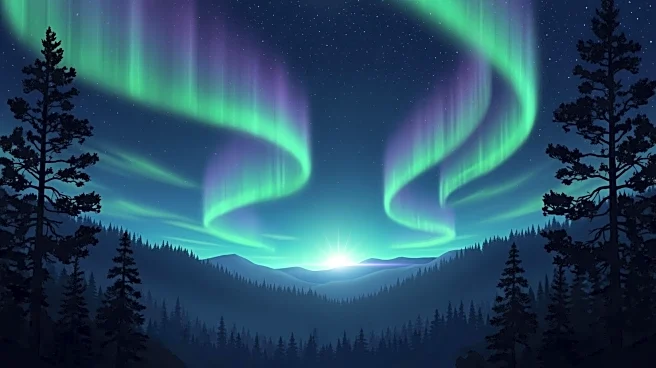
A recent solar flare from the Sun's surface could potentially bring the Aurora Borealis, commonly known as the Northern Lights, as far south as New York State. This phenomenon occurs when solar winds send
charged particles towards Earth, which then interact with the planet's magnetic field and atmospheric gases, creating colorful displays in the sky. The National Oceanic and Atmospheric Administration's Space Weather Prediction Center has indicated that a 'full-halo coronal mass ejection' is expected to impact Earth, possibly causing periods of G3 geomagnetic storming. The increased solar activity is attributed to the Sun being at its peak in its 11-year cycle. However, factors such as the timing, strength of the solar storm, and cloud cover could affect visibility.
Why It's Important?
The potential visibility of the Northern Lights in New York State is significant as it highlights the impact of solar activity on Earth. Such events can affect satellite operations, GPS systems, and power grids, posing challenges for technology-dependent sectors. Additionally, the occurrence of the Aurora Borealis in regions further south than usual underscores the dynamic nature of space weather and its influence on Earth. For residents and tourists, it presents a rare opportunity to witness a natural spectacle typically reserved for higher latitudes, potentially boosting local tourism and interest in astronomy.
What's Next?
If the solar storm is strong enough, residents in New York State may have the chance to observe the Northern Lights. Observatories and astronomy enthusiasts will likely monitor the situation closely, providing updates on visibility conditions. Should the geomagnetic storm materialize as predicted, it could prompt discussions on the preparedness of infrastructure to handle potential disruptions caused by solar activity. Additionally, the event may encourage further research into solar cycles and their effects on Earth.