

What's Happening?
Azadeh Haghighi, an assistant professor at the University of Illinois Chicago (UIC) Department of Mechanical and Industrial Engineering, is leading a NASA-supported project to develop intelligent welding technology for deep-space exploration. This research,
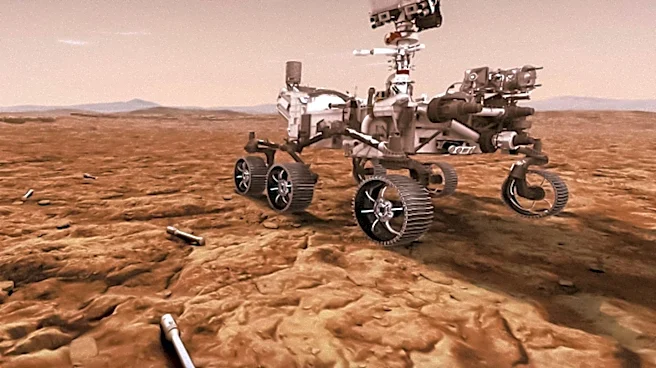
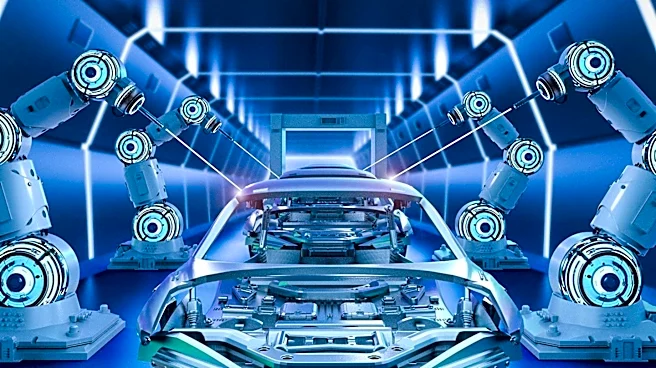
part of the 'Weld-ASSIST' project, aims to enable in-space manufacturing and assembly for future Moon and Mars missions. The technology addresses critical challenges posed by extreme space conditions, including low temperatures, extreme vacuum, and microgravity. These conditions can degrade weldability, alter chemical composition, and lead to defects like porosity. Haghighi's team is developing a digital twin platform that integrates multiscale, multiphysics models with physics-informed machine learning and uncertainty quantification techniques to evaluate welding processes under these harsh environments. The goal is to minimize trial-and-error, ensure high-quality welds, and reduce the costs and time associated with space missions by enabling on-site repairs and construction using local materials like regolith.
Why It's Important?
This research is crucial for the long-term viability of human space exploration, particularly for ambitious missions to the Moon and Mars. The ability to manufacture and assemble structures in space significantly reduces the logistical burden and reliance on Earth-based supply chains, making deep-space missions more feasible and cost-effective. By developing reliable in-space welding techniques, NASA can enable the construction of habitats, repair of spacecraft, and utilization of extraterrestrial resources, which are essential for sustained human presence beyond Earth. The project also fosters the development of a skilled workforce, as UIC students gain experience at the intersection of advanced manufacturing, computational modeling, artificial intelligence, and space exploration, preparing them for careers in the evolving aerospace sector. This advancement could accelerate the timeline for establishing permanent bases on other celestial bodies and expand humanity's reach in the solar system.
What's Next?
The developed models will undergo validation through Earth-based experiments, parabolic flight tests, and existing data from various databases and agencies. This validation process will ensure the reliability and accuracy of the digital twin platform under simulated space conditions. Future steps include extending the technology to support resource utilization on the Moon and Mars, specifically for construction and repair using locally sourced materials such as regolith. The ongoing NASA support for the Weld-ASSIST project indicates a continued commitment to advancing these capabilities. The research will also continue to provide valuable educational opportunities for students, equipping them with skills in physics, computation, AI, and engineering judgment, which are vital for the next generation of advanced manufacturing technologies both in space and on Earth.
Beyond the Headlines
The development of intelligent welding technology for space has broader implications beyond immediate mission objectives. It represents a significant step towards autonomous manufacturing in extreme environments, a capability that could eventually translate to other challenging terrestrial applications, such as disaster relief or hazardous industrial settings. Ethically, it raises questions about the extent of human independence from Earth in space and the potential for self-sustaining off-world economies. Legally, the ability to utilize in-situ resources for construction and repair could influence future international agreements on resource ownership and exploitation in space. Culturally, it reinforces humanity's drive for exploration and innovation, pushing the boundaries of what is technologically possible and inspiring future generations to pursue careers in STEM fields. This technology is a foundational element for a future where humanity is a multi-planetary species.