






What's Happening?
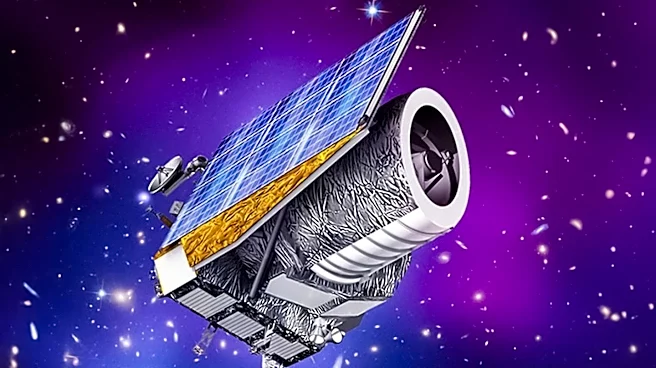
The NASA Nancy Grace Roman Space Telescope team has successfully completed a series of activities to fine-tune the observatory's vision and prepare its primary instrument, the Wide Field Instrument, for routine use. Since its activation in September,
the team has conducted extensive tests on the instrument's components, including its 18 detectors, electronics, and element wheel, which contains filters and tools for light manipulation. They also calibrated the internal LEDs to measure detector response to varying light levels and corrected for sensitivity variations. Furthermore, engineers adjusted the telescope's alignment, moving the secondary mirror by a minuscule amount—approximately one-sixteenth the diameter of a human hair—to achieve near-perfect alignment. This precision was crucial as the team had to account for shifts occurring during launch and in the space environment. The Wide Field Instrument's performance is now nearly 30% better than predicted, with an optical error of just 63 nanometers RMS, surpassing the initial requirement of 90 nanometers RMS. The Coronagraph Instrument also saw its focus fine-tuned, and its performance now meets expectations, with further calibration of camera settings and deformable mirrors planned.
Why It's Important?
The successful calibration and focusing of the Nancy Grace Roman Space Telescope's instruments are critical for its ambitious scientific objectives, particularly in the study of dark matter and dark energy. The enhanced performance of the Wide Field Instrument, now 30% better than anticipated, means that images from Roman's cosmic surveys will be significantly sharper, leading to more precise data and potentially groundbreaking discoveries. This achievement underscores NASA's advanced capabilities in optical engineering and space instrument development, demonstrating the ability to overcome the challenges of launching and operating complex telescopes in space. The precision achieved, with optical errors reduced to 63 nanometers RMS, highlights the meticulous planning and execution involved in such missions. The ability to fine-tune instruments to such a degree after deployment is a testament to the engineering prowess that will enable scientists to gather unprecedented insights into the universe's mysteries, ultimately advancing humanity's understanding of cosmic phenomena and the fundamental laws of physics.
What's Next?
Following the successful fine-tuning of its focus, the Coronagraph Instrument team will proceed with calibrating its camera settings and determining the optimal settings for its deformable mirrors. These steps are crucial before the team attempts to demonstrate the instrument's light-blocking capabilities in the coming weeks. This demonstration is a key milestone for the Coronagraph Instrument, as its ability to block out starlight is essential for directly imaging exoplanets and studying their atmospheres. The continued calibration and testing phases will ensure that both the Wide Field Instrument and the Coronagraph Instrument are fully prepared for their scientific missions. The improved performance of the Wide Field Instrument suggests that the Roman Space Telescope is well-positioned to deliver high-quality data, which will then be analyzed by scientists to further our understanding of the universe. The ongoing work will solidify the telescope's readiness to embark on its sweeping cosmic surveys, contributing significantly to astrophysics and space science.
Beyond the Headlines
The meticulous calibration of the Roman Space Telescope's instruments, particularly the minute adjustments made to its mirrors, highlights the extraordinary precision required in modern astrophysics. The ability to correct for shifts that occur during launch and in the zero-gravity environment of space, achieving an optical error thousands of times thinner than a human hair, pushes the boundaries of engineering and metrology. This level of precision is not merely technical; it reflects a deeper commitment to scientific rigor and the pursuit of knowledge. The Roman Space Telescope's mission to study dark matter and dark energy touches upon some of the most profound questions in cosmology, questions that have implications for our understanding of the universe's origins, evolution, and ultimate fate. The success of this calibration phase ensures that the data collected will be of the highest quality, minimizing uncertainties and maximizing the potential for transformative discoveries that could reshape our cosmic worldview and inspire future generations of scientists and engineers.