




What's Happening?
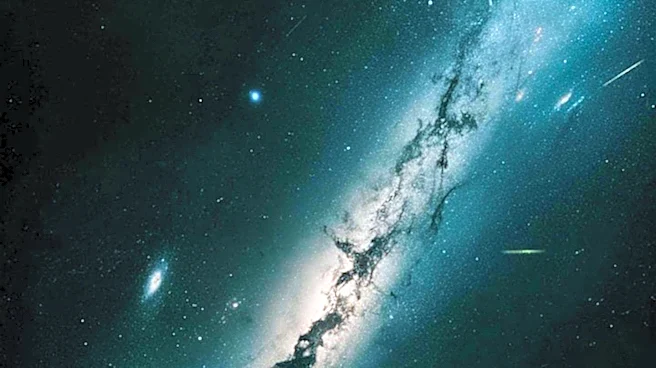
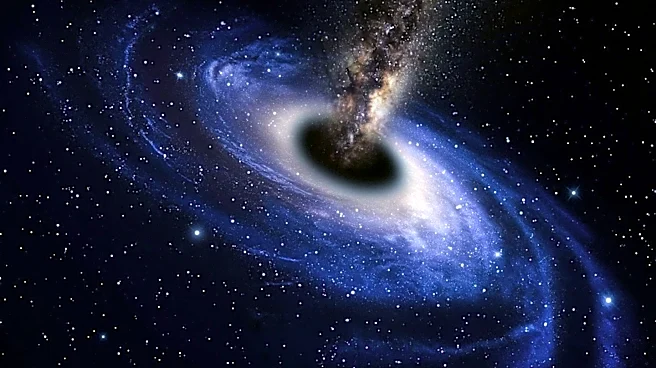
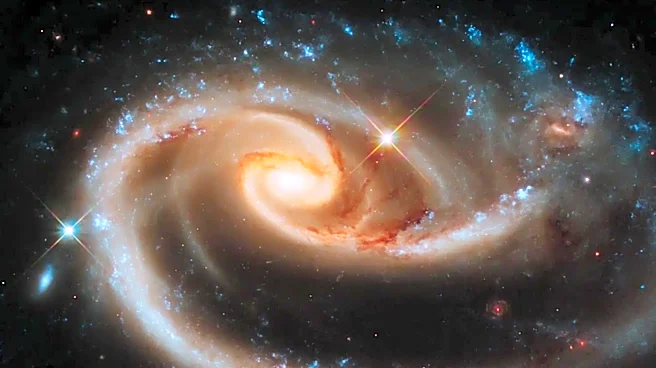
Astronomers have suggested that a collision with the Gaia Sausage dwarf galaxy around 10 billion years ago may have flipped the Milky Way by more than 90 degrees. This event, which occurred long before the solar system existed, involved the smaller Gaia Sausage galaxy colliding
directly with the Milky Way. The impact was significant enough to potentially rotate the Milky Way's entire disc into its current position. Researchers from Durham University presented these findings at the Royal Astronomical Society's National Astronomy Meeting. The study used advanced supercomputer simulations to show that such collisions can lead to a 'disc flip,' a gradual reorientation of the galaxy over hundreds of millions of years.
Why It's Important?
This discovery provides new insights into the history and evolution of the Milky Way. Understanding such cosmic events can help astronomers piece together the galaxy's past and its structural changes over billions of years. The collision with the Gaia Sausage galaxy is considered the Milky Way's last major merger, playing a crucial role in shaping its central bulge and stellar halo. This research also highlights the dynamic nature of galaxies and the potential for future mergers, although none are expected to have as dramatic an impact as the Gaia Sausage collision. These findings contribute to the broader understanding of galactic formation and evolution.