

What's Happening?
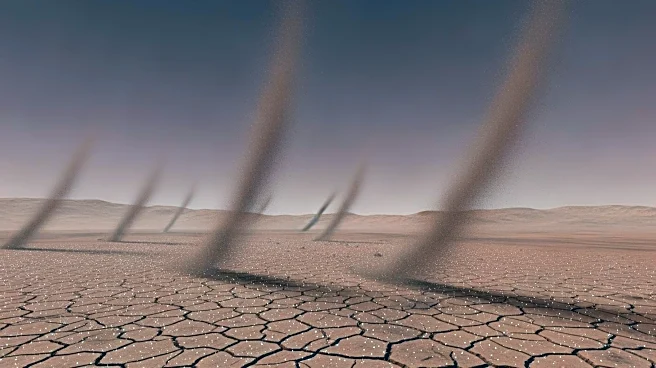
A recent study has identified a new mechanism contributing to water loss on Mars, involving localized 'rocket dust storms' that lift water vapor into the upper atmosphere, allowing hydrogen to escape. This discovery, based on observations from Mars Year
37, reveals that these storms can occur during the northern summer, a period typically less active in terms of dust storms. The findings provide new insights into the historical climate changes on Mars and the processes that have led to its current arid state.
Why It's Important?
Understanding the mechanisms behind Mars' water loss is crucial for reconstructing the planet's climatic history and assessing its potential for past habitability. The study's findings suggest that localized dust storms could have played a significant role in Mars' transition from a water-rich environment to its present desert-like conditions. This knowledge is vital for future Mars exploration missions, as it informs scientists about the planet's atmospheric dynamics and helps refine models predicting its climate evolution.
Beyond the Headlines
The discovery of rocket dust storms as a factor in Mars' water loss challenges previous assumptions that only global dust storms were responsible. This highlights the complexity of Martian atmospheric processes and suggests that similar localized events may have been more common in the planet's past. The research opens new avenues for studying how such storms could affect other planetary bodies with thin atmospheres, enhancing our understanding of planetary science.