







What's Happening?
The $3.9 billion Hampton Roads Bridge-Tunnel (HRBT) Expansion project in Virginia is nearing its final stages, with substantial completion targeted for 2027. This massive infrastructure undertaking, the largest highway construction program in Virginia's
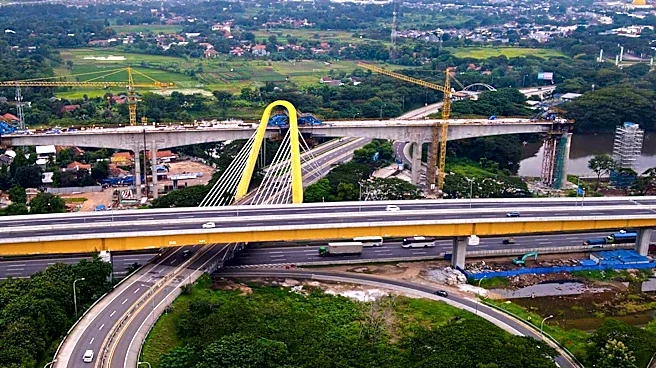
history, spans approximately 9.9 miles of Interstate 64 between Norfolk and Hampton. Its centerpiece involves two new 1.5-mile bored tunnels beneath Hampton Roads Harbor, constructed using a 4,700-ton tunnel boring machine named Mary. Mary completed its final breakthrough in September 2025, having excavated over 1 million cubic yards of material. Currently, construction teams are focusing on completing the tunnel interiors, installing mechanical and electrical systems, building new bridge connections, and preparing the expanded corridor for traffic. The project also includes extensive bridge construction, highway widening, and improvements to the surrounding road network, aiming to increase traffic lanes across the harbor from four to eight.
Why It's Important?
This expansion is crucial for the Hampton Roads region, which hosts a significant concentration of U.S. military installations, the Port of Virginia, major logistics operations, and manufacturing facilities. The existing HRBT, designed for 70,000 vehicles daily, now handles over 100,000, leading to severe congestion. The project's completion will double the traffic capacity, significantly improving regional connectivity, reducing travel times for commuters and commercial vehicles, and supporting the area's economic growth. The use of bored tunnels, Virginia's first for roadways, minimizes disruption to the active commercial and military shipping channel, showcasing advanced U.S. tunneling industry capabilities. This infrastructure upgrade is vital for maintaining efficient transportation for both civilian and military operations, directly impacting national defense logistics and regional commerce.
What's Next?
As of late 2026, the project is in its final major construction phase, with teams working on roadway formation, drainage systems, mechanical and electrical installations, and emergency safety facilities within the tunnels. The new tunnels will require extensive lighting, ventilation, communications, and traffic monitoring equipment, along with fire detection and suppression systems. A new tunnel operations facility on the North Island will centralize monitoring and incident response. The project, delivered by Hampton Roads Connector Partners for the Virginia Department of Transportation (VDOT), is expected to achieve substantial completion in February 2027, with final completion later that year. The remaining work involves rigorous testing and commissioning to ensure the expanded crossing is safe and fully operational for public use.
Beyond the Headlines
The Hampton Roads Bridge-Tunnel Expansion highlights the complex engineering and logistical challenges involved in modern heavy civil construction, particularly in active marine environments. The project's success demonstrates the integration of underground engineering, marine construction, and highway development to address long-term transportation needs. It also underscores the economic and strategic importance of robust infrastructure for regions with significant military and commercial activity. The project's scale and technical demands have fostered specialized expertise in tunneling, bridge engineering, and project management, contributing to the broader U.S. construction industry's capabilities. The ability to execute such a large-scale project while maintaining an operational transportation network sets a precedent for future infrastructure developments in densely populated and strategically vital areas.