




What's Happening?
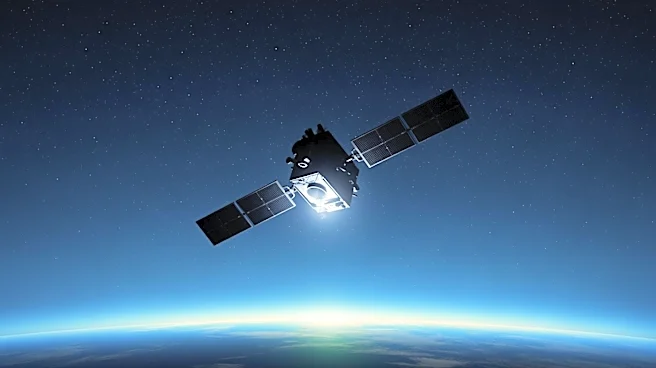
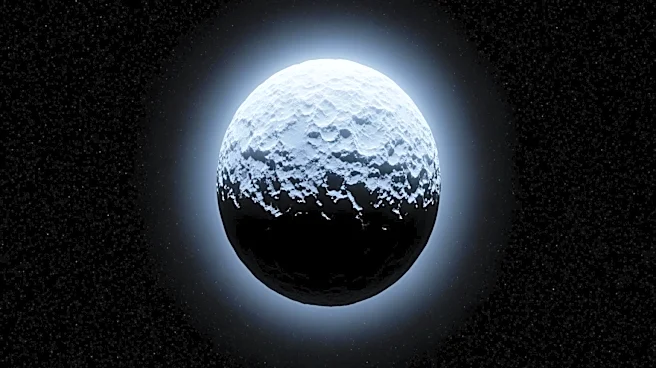
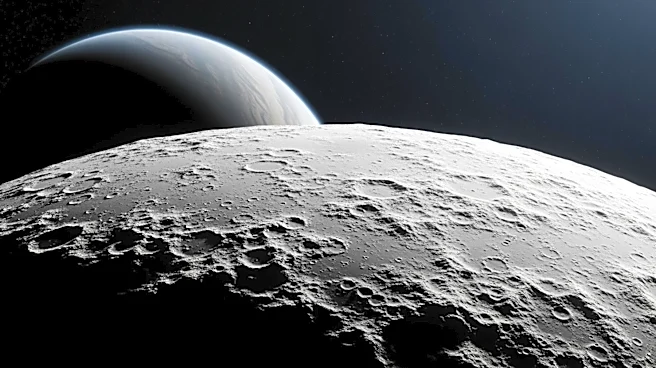
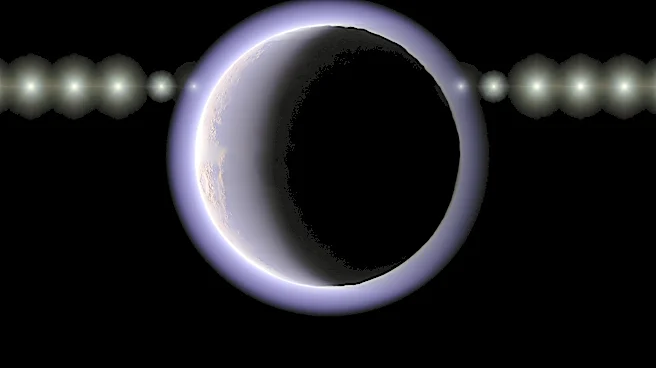
NASA's Juno spacecraft has successfully captured a high-resolution image of Thebe, one of Jupiter's inner moons, during a close flyby on May 1, 2026. The image was taken from a distance of approximately 3,100 miles, with a resolution of about 1.9 miles per
pixel. Thebe, located at the outer edge of Jupiter's faint ring system, is believed to contribute to the formation of the planet's 'gossamer' ring through dust shedding. The spacecraft's Stellar Reference Unit, primarily used for navigation, demonstrated its secondary capability as a science instrument by capturing this detailed image.
Why It's Important?
The detailed imaging of Thebe provides significant insights into the composition and behavior of Jupiter's moons and their interaction with the planet's ring system. Understanding these dynamics is crucial for comprehending the broader processes governing planetary ring systems and their evolution. The data collected by Juno enhances our knowledge of Jupiter's moons, contributing to the scientific community's efforts to unravel the complexities of the solar system. This mission exemplifies the dual utility of space instruments, which can serve both navigational and scientific purposes, thereby maximizing the value of space exploration missions.