

What's Happening?
Radiosynthesis, a theoretical concept, is being explored as a potential process that allows organisms to survive without sunlight by relying on ionizing radiation. This process is inspired by photosynthesis and chemosynthesis, where organisms use light and chemical
energy, respectively, to sustain life. Radiosynthesis suggests that ionizing radiation could serve as an alternative energy source, particularly in environments devoid of light. The concept is gaining attention in the search for extraterrestrial life, as it could explain how life might exist in harsh, radioactive environments. Studies have shown that certain fungi, such as those found in the Chernobyl reactor, thrive in high-radiation areas, possibly due to radiosynthesis. This research is opening new avenues in astrobiology, particularly in the exploration of planets and moons where sunlight is absent but cosmic radiation is present.
Why It's Important?
The exploration of radiosynthesis is significant as it challenges traditional views of habitability, which typically require sunlight. If proven, radiosynthesis could expand the criteria for habitable environments beyond Earth, influencing future space missions and the search for life on other planets. This concept could redefine astrobiology by suggesting that life could exist in environments previously considered uninhabitable. The potential discovery of life forms that utilize ionizing radiation could have profound implications for our understanding of life's adaptability and resilience. Additionally, this research could impact industries related to space exploration and environmental science, as it may lead to new technologies for detecting and studying life in extreme conditions.
What's Next?
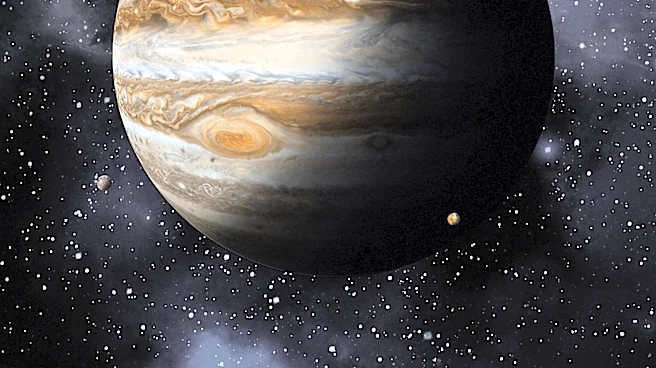
Future space missions, such as NASA's Europa Clipper and ESA's Jupiter Icy Moons Explorer, are expected to provide data that could support or refute the radiosynthesis hypothesis. These missions aim to explore the icy moons of Jupiter and Saturn, where conditions might support radiosynthesis. The development of specialized instruments capable of detecting radioactive isotopic anomalies and potential biomarkers will be crucial in testing this hypothesis. As research progresses, the scientific community will continue to debate and investigate the viability of radiosynthesis as a biological process, potentially leading to groundbreaking discoveries in astrobiology.