



What's Happening?
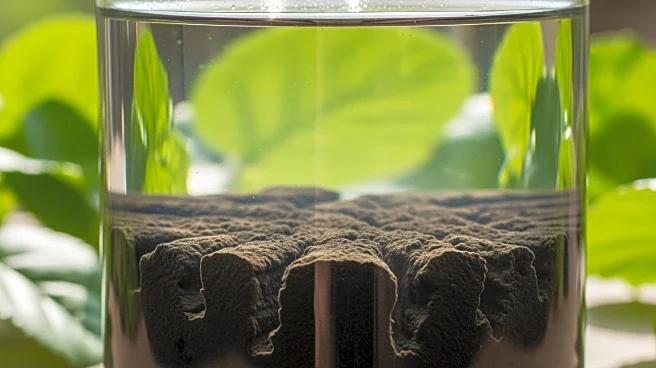
Researchers have discovered that naturally formed sludge from wetlands can effectively remove dyes and heavy metals from wastewater, offering a low-energy alternative to traditional water treatment methods. This sludge, which forms without human intervention,
contains microbial communities and organic matter that enhance its pollutant-binding capabilities. In a study, sludge collected from a wetland near Egypt's Ismailia Canal demonstrated high adsorption capacities for methylene blue dye and lead ions, with removal efficiencies of 78.6 mg/g and 52.3 mg/g, respectively. The sludge's reusability was also confirmed, retaining around 80% of its capacity after five cycles of pollutant removal and regeneration.
Why It's Important?
The use of natural sludge for water purification presents a sustainable and cost-effective solution, particularly in regions with limited resources for conventional treatment. This approach reduces the need for energy-intensive processes and chemical treatments, making it an environmentally friendly alternative. The ability to reuse the sludge multiple times without significant loss of efficiency further enhances its practicality for large-scale applications. This development could significantly impact industries reliant on water purification, such as textiles and manufacturing, by providing a more sustainable method for managing wastewater.
What's Next?
While promising, the large-scale application of natural sludge for water purification faces challenges, including variability in sludge composition and logistical issues related to collection. Future research may focus on optimizing the collection and processing of natural sludge to ensure consistent performance. Additionally, integrating this method with existing water treatment systems could enhance its effectiveness and scalability. Exploring regional sourcing strategies and improvements like solar-assisted drying could further increase the sustainability and feasibility of this approach.
Beyond the Headlines
The discovery of natural sludge's potential in water purification underscores the value of leveraging natural processes for environmental management. This approach aligns with broader trends in sustainable development and circular economy practices, where waste materials are repurposed for beneficial uses. The study highlights the importance of interdisciplinary research in uncovering innovative solutions to environmental challenges, potentially inspiring further exploration of natural materials in other applications.