


What's Happening?
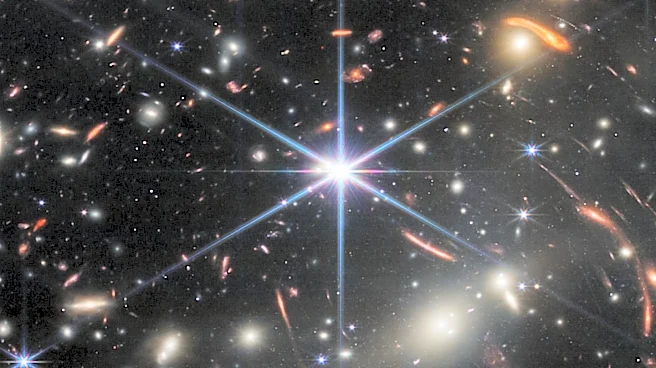
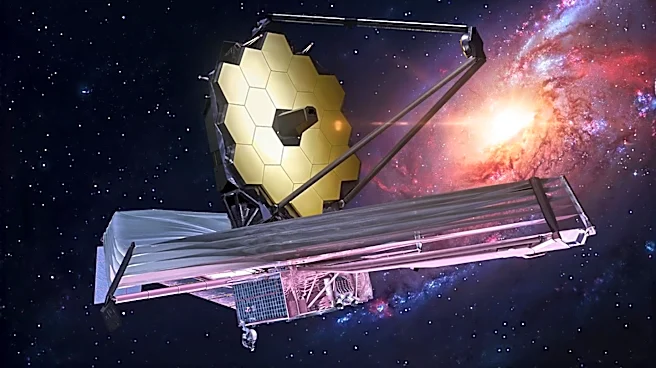
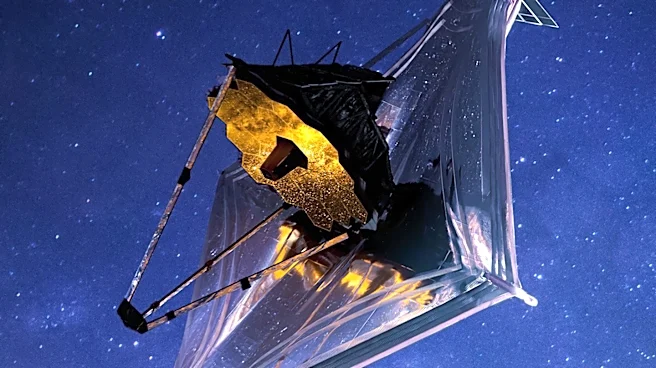
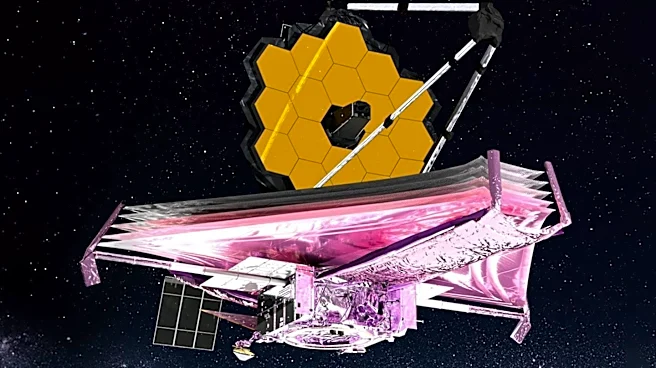
The James Webb Space Telescope (JWST) has identified a solar-system-sized 'dot' from the early universe, named MoM-BH-1, which researchers believe could be the most promising candidate yet for a 'black hole star.' This object, observed approximately 660
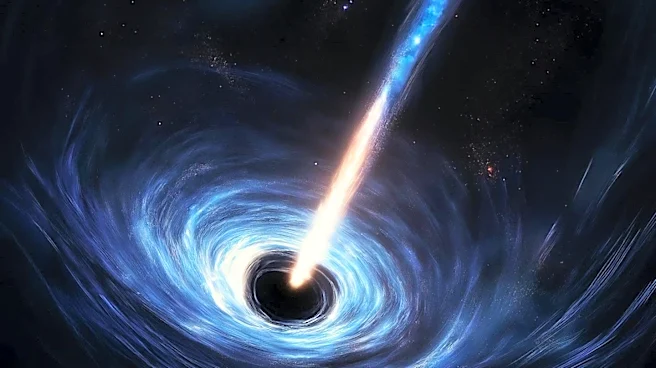
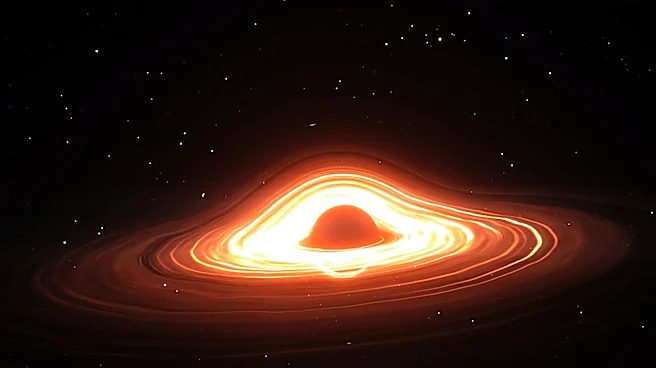
million years after the Big Bang, shines with a luminosity roughly 100 billion times that of the Sun. Unlike typical stars powered by nuclear fusion, MoM-BH-1 is theorized to be an enormous ball of dense gas superheated by a central black hole. This discovery, published in the journal Nature, emerged from JWST's Miracle or Mirage (MoM) survey, which focuses on distant galaxies. The object's striking ruby hue and the absence of certain light wavelengths (Balmer break) suggest it is surrounded by an extremely dense shell of gas, composed almost purely of hydrogen and helium, and severely lacking in heavy metals. Simulations indicate that a hefty black hole is hidden within this gas, which is believed to be a supermassive black hole weighing up to 100,000 solar masses.
Why It's Important?
This potential 'black hole star' offers a significant step towards unraveling the mystery of 'little red dots' (LRDs), a group of hundreds of distant, crimson lights observed by JWST. LRDs are a major puzzle in modern astronomy because they are too bright to be ordinary stars but too dim to be fully formed galaxies. The black hole star hypothesis could explain why these objects do not emit detectable high-energy radiation, as their dense gas cocoons could block such emissions, masking their true nature. If confirmed, this finding could reshape our understanding of how supermassive black holes and early cosmic structures formed and evolved. It suggests a new class of astrophysical objects that bridge the gap between stars and galaxies in terms of luminosity and could provide crucial insights into the universe's 'cosmic dawn,' offering a clearer picture of the conditions and processes that existed shortly after the Big Bang.
What's Next?
Further research is necessary to confirm MoM-BH-1 as a black hole star and to understand its implications for the broader population of 'little red dots.' Scientists will continue to analyze data from JWST and potentially other observatories to gather more evidence about the object's composition, dynamics, and energy source. The team also plans to investigate how black hole stars form and how large they can become, as many LRDs are significantly larger than MoM-BH-1. Researchers suspect that most LRDs might actually be mini-galaxies with a black hole star at their core, possibly formed through collisions between black hole stars and primordial stellar clusters. Future observations will aim to determine if MoM-BH-1 is already part of a larger galactic structure or if it is truly a standalone black hole star outshining its potential host galaxy. The ongoing study of these objects will refine cosmological models and our understanding of the early universe.
Beyond the Headlines
The concept of a 'black hole star' challenges conventional astrophysical models by proposing a mechanism where a black hole, rather than nuclear fusion, powers a star-like object. This discovery pushes the boundaries of our understanding of stellar evolution and the role of black holes in the early universe. It highlights the dynamic and often unexpected ways cosmic phenomena can manifest, especially in extreme conditions. The potential for dense gas cocoons to mask the high-energy radiation typically associated with black holes also introduces a new consideration for how astronomers identify and characterize these elusive objects. This could lead to a re-evaluation of previously observed cosmic phenomena, suggesting that some objects currently classified as quasars or other types of galaxies might, in fact, be black hole stars. The ongoing exploration of such exotic objects underscores the vast unknowns that still exist in cosmology and the continuous evolution of our scientific understanding.