








What's Happening?
The U.S. Department of Energy (DOE) has initiated the Battery Manufacturing Accelerator (BattMan), a new national consortium aimed at enhancing domestic battery manufacturing capabilities. Announced on October 28, this initiative brings together four
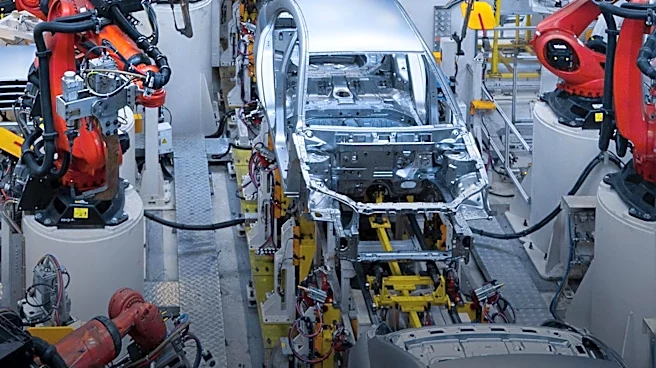
national laboratories and five universities, with Pacific Northwest National Laboratory leading the effort. The consortium also seeks collaboration with industry partners. BattMan's primary goal is to reduce production costs and improve the quality of batteries through the application of artificial intelligence, advanced sensors, and automated manufacturing systems. A key focus is on minimizing waste during battery electrode manufacturing, where scrap rates can currently reach as high as 40%. Researchers aim to cut this figure to under 5% by implementing real-time monitoring and automated process controls. This technological advancement is expected to allow manufacturing equipment to self-detect issues and adjust production processes, thereby reducing material waste, improving consistency, and lowering the overall cost of battery cell production. The research will cover both conventional lithium-ion batteries and emerging battery technologies, with some work conducted at Oak Ridge National Laboratory’s Battery Manufacturing Facility in Tennessee.
Why It's Important?
This initiative is crucial for strengthening the U.S. domestic battery supply chain, particularly for critical applications such as drones, transportation, energy storage, and defense systems. The U.S. currently faces challenges in establishing a reliable and competitive domestic battery manufacturing sector, with limited production capacity and intense competition from established overseas suppliers. By improving manufacturing processes and reducing costs, BattMan aims to make U.S.-produced batteries more commercially competitive and less reliant on foreign sources. This move aligns with broader government and private sector efforts to decrease dependence on imported components, especially for the drone industry, where battery cells remain a significant hurdle. Successful implementation of BattMan's research could accelerate the transition of new battery technologies from laboratory development to commercial production, fostering innovation and creating a more resilient domestic manufacturing base. This could also lead to job creation and economic growth within the advanced manufacturing sector.
What's Next?
The BattMan consortium will continue its research and development efforts, focusing on integrating artificial intelligence, advanced sensors, and automated systems into battery manufacturing processes. While a specific timeline for commercial production has not been announced, the initiative is expected to attract industry partners who will play a vital role in scaling up these advancements. The research conducted at facilities like Oak Ridge National Laboratory will be critical in refining these new manufacturing techniques. Future steps will likely involve pilot programs with manufacturers to test and validate the improved processes in real-world production environments. The success of BattMan could lead to increased investment in U.S. battery manufacturing facilities, further reducing reliance on foreign suppliers and bolstering national security through a more secure domestic supply chain for critical technologies. The consortium will also explore how to best transition emerging battery technologies from research labs to commercial viability.
Beyond the Headlines
Beyond the immediate economic and supply chain benefits, BattMan's focus on reducing waste in battery manufacturing has significant environmental implications. By aiming to cut electrode production scrap rates from 40% to under 5%, the initiative will substantially decrease material consumption and waste generation, contributing to more sustainable manufacturing practices. This aligns with broader environmental goals of reducing industrial footprint and promoting a circular economy. Furthermore, the emphasis on advanced automation and AI in manufacturing could set new industry standards for efficiency and quality control, potentially influencing global battery production methodologies. The initiative also highlights the strategic importance of domestic technological independence, particularly in critical sectors like defense and energy storage, where reliance on foreign suppliers can pose geopolitical risks. The long-term success of BattMan could position the U.S. as a leader in advanced battery manufacturing, driving innovation and competitiveness on a global scale.