









What's Happening?
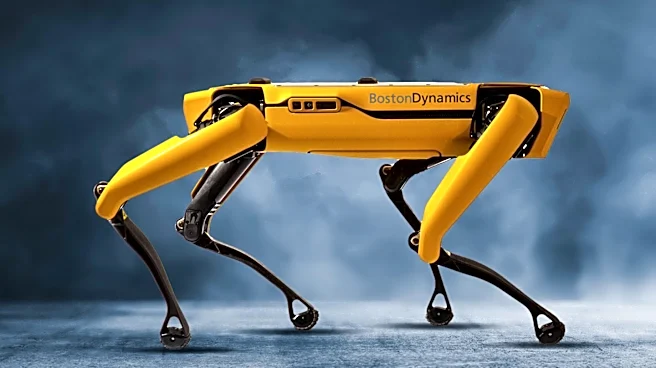
A robot dog named KAIST HOUND has demonstrated advanced mobility capabilities, including climbing stairs, navigating forests, and bounding over logs, thanks to a new AI training technique. Developed by researchers, this technique, known as action pretrained
transformer-based reinforcement learning (APT-RL), allows the robot to adapt its gait in real-time based on its environment. The robot uses cameras and lidar to scan its surroundings and select the most appropriate movements. This development marks a significant advancement in robotics, enabling the robot to perform complex tasks without human intervention.
Why It's Important?
The advancements in the KAIST HOUND robot dog highlight significant progress in robotics and AI, with potential applications across various industries. The ability to navigate complex terrains autonomously could revolutionize fields such as search and rescue, military operations, and environmental monitoring. The use of AI to enable real-time adaptability in robots represents a leap forward in creating machines that can operate effectively in dynamic and unpredictable environments. This technology could lead to more efficient and versatile robotic systems, reducing the need for human oversight and expanding the potential for automation in challenging settings.
What's Next?
Following the successful demonstration of the KAIST HOUND's capabilities, further research and development are likely to focus on refining and expanding the robot's abilities. Future iterations may include enhanced sensors and improved AI algorithms to tackle even more complex tasks. The technology could also be adapted for other robotic platforms, broadening its application scope. As the technology matures, it may attract interest from commercial and governmental entities seeking to leverage advanced robotics for specific operational needs. Additionally, ethical considerations regarding the deployment of autonomous robots in sensitive environments may become a topic of discussion.