



What's Happening?
A new study published in the journal 'Science' suggests that the Yellowstone supervolcano is powered by a 'mantle wind' rather than a deep plume of molten rock. This challenges the traditional view that the supervolcano's magma is supplied by a deep mantle plume.
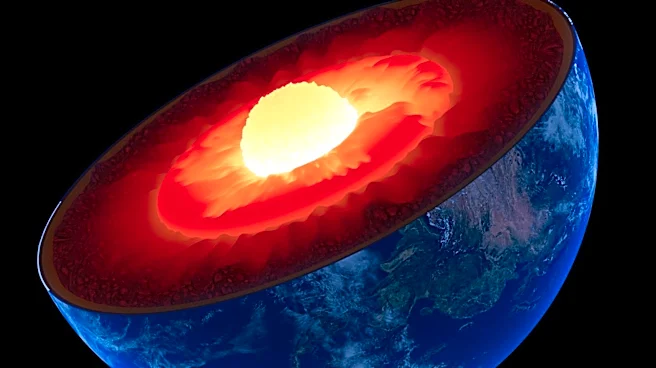
Researchers from the Institute of Geology and Geophysics of the Chinese Academy of Sciences developed a three-dimensional model of western North America, revealing that the magma is fed by a broad underground flow of hot rock moving through the upper mantle beneath North America. This 'mantle wind' is believed to originate from the remnants of the ancient Farallon Plate, which still lies beneath central and eastern North America. The study also suggests that the magma is distributed through vast regions of partially molten rock, known as 'magma mush' systems, rather than large, long-lasting chambers of liquid magma.
Why It's Important?
Understanding the mechanisms that power supervolcanoes like Yellowstone is crucial due to their potential to cause massive eruptions with global impacts on climate, ecosystems, and human societies. The new findings provide a clearer explanation of how giant magma systems develop beneath supervolcanoes, which could improve predictions of future eruptions. The study also offers insights into the long-lived magma mush systems believed to exist beneath many of the world's supervolcanoes. This research could influence future geological and geophysical studies, as well as inform public policy and emergency preparedness strategies in regions near supervolcanoes.
What's Next?
The study's findings may lead to further research into the dynamics of mantle winds and their role in volcanic activity. Scientists may conduct additional studies to validate the model and explore its implications for other supervolcanoes around the world. The research could also prompt a reevaluation of existing geological models and influence the development of new monitoring techniques to better understand and predict volcanic activity. Stakeholders, including government agencies and emergency management organizations, may use this information to enhance preparedness and response plans for potential volcanic eruptions.