



What's Happening?
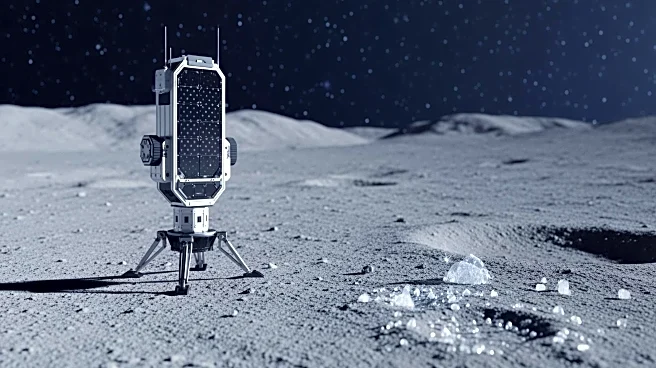
NASA is collaborating with international partners to explore the Moon's South Pole for water ice, a critical resource for future lunar missions. The Neutron Spectrometer System (NSS), developed by NASA's Ames Research Center and Lockheed Martin, will
be installed on the Lunar Polar Exploration (LUPEX) mission's rover, led by JAXA and ISRO. This instrument aims to detect ice beneath the lunar surface, providing essential data for future human exploration. The NSS will help identify potential landing sites by mapping the distribution of lunar ice, which is crucial for sustaining human presence on the Moon. The mission is part of NASA's broader Artemis campaign and Commercial Lunar Payload Services effort.
Why It's Important?
The discovery and mapping of water ice on the Moon are vital for NASA's long-term lunar exploration goals. Water is not only essential for life support but can also be converted into breathable air and rocket fuel, reducing the need to transport these resources from Earth. This capability could significantly lower the cost and increase the sustainability of lunar missions. By understanding the distribution of ice, NASA can plan future missions more effectively, ensuring that astronauts have access to necessary resources. This initiative also strengthens international collaboration in space exploration, leveraging expertise from JAXA and ISRO.
What's Next?
The LUPEX mission is scheduled to arrive at the Moon no earlier than 2028. In the meantime, NASA will continue to develop and deploy NSS instruments on various missions to gather more data on lunar ice. The upcoming VIPER mission, part of the Artemis campaign, will also carry an NSS to further explore the Moon's South Pole. These efforts will inform NASA's strategy for establishing a sustainable human presence on the Moon, potentially paving the way for future Mars exploration.