






What's Happening?
New guidance from the ASEAN Taxonomy warns against 'false' adaptation solutions that exacerbate fire and extreme heat risks, particularly as Southeast Asia faces its worst transboundary haze in a decade. The guidance, launched by the ASEAN Capital Markets
Forum (ACMF) and ASEAN Taxonomy Board, specifically rules out monoculture tree farms on peatlands and planting trees over drained peatlands or intact natural forests, which are often disguised as restoration projects. These practices are identified as worsening fire risks and conflicting with mitigation objectives. Instead, the guidance advocates for credible adaptation measures such as peatland rewetting and community-led fire prevention and management initiatives. The aim is to mobilize private capital for the region's estimated US$129 billion annual adaptation needs by 2030, by clearly defining what constitutes credible adaptation activities and measurable outcomes.
Why It's Important?
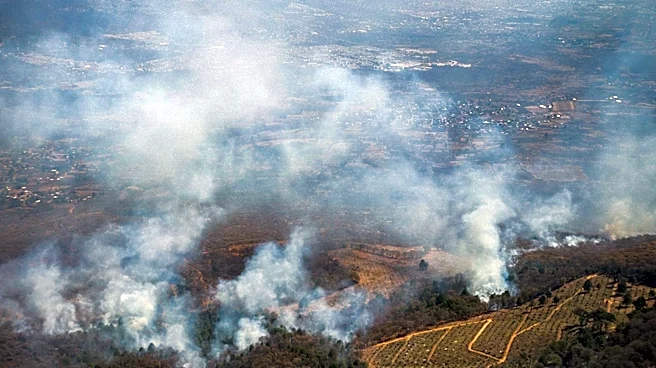
This guidance is crucial because misdirected 'restoration' efforts can inadvertently worsen environmental problems, leading to what is termed 'maladaptation.' Monoculture plantations on peatlands, for instance, can dry out local rivers and increase fire susceptibility, as seen with the 2015 fires in Indonesia that released more carbon per day than the entire U.S. economy at their peak. By providing clear criteria for credible adaptation solutions—requiring clear risk fit, proven effect, viability under uncertainty, and no conflict with mitigation objectives—ASEAN aims to ensure that investments genuinely contribute to resilience. This clarity is essential for attracting private capital, as investors need confidence that their funds will support effective and sustainable projects. The focus on preventing peat and forest fires also addresses a significant public health and economic issue caused by transboundary haze, which impacts millions across the region.
What's Next?
The ACMF plans to initiate broader stakeholder consultations on this guidance in the first quarter of 2027, which will inform future iterations. The next version is expected to expand its sector coverage beyond agriculture, forestry, fishing, water management, and construction, and further strengthen approaches for screening maladaptation. The goal is to encourage these actions to be translated into concrete projects and investments, giving capital providers greater confidence. The guidance is intended as a voluntary, non-binding complement to the ASEAN Taxonomy, suggesting that its effectiveness will rely on adoption by member states and the financial sector. Continued efforts will focus on mobilizing both public and private resources to meet the substantial adaptation needs of the region, particularly in addressing hazards like flooding, drought, sea level rise, and extreme heat.
Beyond the Headlines
The ASEAN guidance on 'false' forest restoration highlights a critical challenge in global climate action: the potential for well-intentioned but poorly executed environmental projects to cause more harm than good. This issue extends beyond Southeast Asia, as many regions grapple with defining and implementing effective climate adaptation strategies. The emphasis on community-led prevention and the caution against relying on unpaid volunteer labor also underscore the social equity dimensions of climate action, ensuring that the burden of adaptation does not disproportionately fall on vulnerable communities. This initiative reflects a growing sophistication in climate finance, moving beyond simple carbon offsetting to a more nuanced understanding of ecological and social impacts. It also signals a regional commitment to robust environmental governance and sustainable development, which could influence international standards and practices in climate adaptation and green finance.