






What's Happening?
Mara, a San Francisco-based company, has successfully raised $7 million in funding to advance its proprietary counter-drone system named 'Spike.' This system is specifically designed to combat drone swarms, addressing a significant challenge on the modern
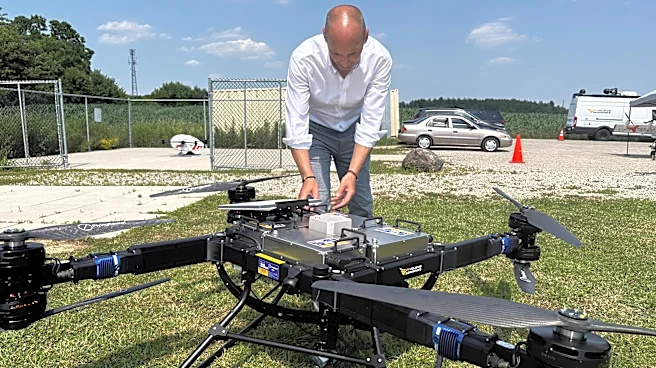
battlefield where inexpensive FPV (first-person-view) drones are increasingly prevalent. The current issue is that the cost to neutralize these drones using traditional methods like electronic warfare (EW) or interceptor missiles far exceeds the cost of the drones themselves. Furthermore, EW is becoming less effective as drones incorporate fiber-optic cables or autonomous navigation. Spike aims to provide a low-cost, close-in defense solution when EW fails. The system consists of two main components: the 'spotter,' which uses cameras, microphones, and optional radar with AI to identify and track drones, and the 'seeker,' an 8.8-ounce interceptor that flies at 124 mph to physically collide with and destroy incoming drones. Human operators maintain oversight, setting rules of engagement for the semi-autonomous system.
Why It's Important?
The development of Mara's 'Spike' system is crucial for U.S. national security and defense strategy, particularly in addressing the evolving threat of drone warfare. The proliferation of low-cost FPV drones has created an asymmetry on the battlefield, making it economically unsustainable to counter them with high-cost conventional air defense systems. Spike's low-cost, distributed approach offers a potential solution to this problem, allowing for the simultaneous engagement of multiple targets, which is a significant advantage over traditional single-line-of-fire weapons. This innovation could reduce the financial burden of defending against drone swarms and enhance the protection of critical assets and personnel. The system's 'attritable' design means it can be sacrificed if necessary, further contributing to cost-effectiveness. This technology could also influence future military procurement and research and development priorities, shifting focus towards more affordable and scalable defense mechanisms against autonomous threats.
What's Next?
With the new funding, Mara plans to bring its 'Spike' counter-drone technology to market. This will likely involve further testing, refinement, and potential deployment to military and defense sectors. The company will need to demonstrate the system's effectiveness in real-world scenarios and scale up production to meet potential demand. There may also be efforts to integrate 'Spike' with existing defense infrastructures and explore partnerships with government agencies. The success of this system could lead to broader adoption of similar low-cost, autonomous defense solutions, potentially influencing the development of new military doctrines and procurement strategies for countering drone threats. Continued advancements in AI and sensor technology will likely further enhance the capabilities of such systems, making them more precise and adaptable to diverse operational environments.
Beyond the Headlines
The emergence of systems like 'Spike' highlights a broader shift in military technology towards autonomous and cost-effective solutions, driven by the changing nature of modern warfare. The emphasis on 'agnostic hardware' that can be integrated across various drone platforms, as mentioned in related discussions, suggests a move towards modular and adaptable defense systems. This trend could democratize access to advanced military capabilities, potentially impacting geopolitical stability. Ethical considerations surrounding autonomous weapons systems, even those with 'human on the loop' oversight, will become increasingly prominent. The ability of smaller, cheaper drones to disrupt traditional military advantages also underscores the importance of continuous innovation in defense, moving beyond reliance on expensive, high-tech solutions to embrace more agile and distributed approaches. This technological arms race in drone and counter-drone capabilities will likely reshape future conflict dynamics and defense spending priorities.