



What's Happening?
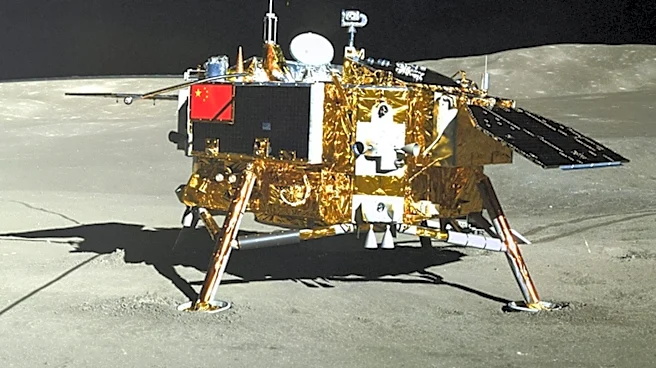
China's Chang'e-6 mission successfully returned 1,935.3 grams (approximately 4.27 pounds) of rock and soil samples from the Moon's South Pole-Aitken Basin, marking the first time humanity has obtained confirmed material from the lunar far side. This achievement
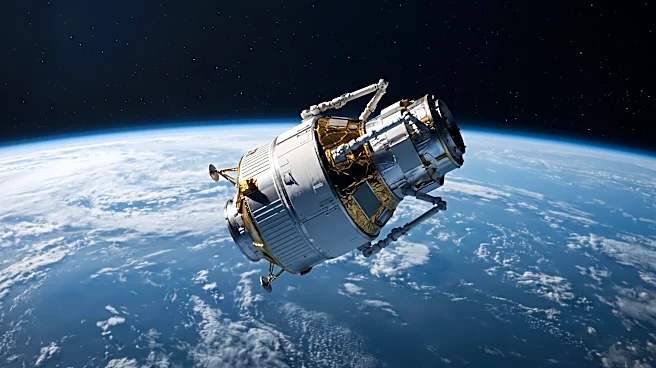
addresses a long-standing challenge in space exploration, as direct radio communication with the far side is impossible from Earth. The mission utilized a complex sequence involving four spacecraft and a relay satellite, Queqiao-2, launched in March 2024, to establish a two-way communication bridge. The samples were collected from a 1,550-mile-wide crater, one of the oldest and largest impact scars in the solar system. Scientists believe these samples will provide critical insights into the Moon's evolution, the origins of our solar system, and future lunar colonization efforts.
Why It's Important?
The retrieval of lunar far side samples is a monumental step in space science, offering unprecedented opportunities to study the Moon's hidden hemisphere. The near and far sides of the Moon exhibit striking differences, including varying volcanic features and crustal thickness. By comparing these new samples with those from the near side, scientists aim to definitively understand the reasons behind this asymmetry and its implications for the Moon's formation and shared origin with Earth. Furthermore, the South Pole-Aitken Basin, where the samples were collected, is a cosmic time capsule, potentially holding clues about the early history of our solar system. Initial findings from Chinese researchers indicate that far side fragments contain more radioactive materials, suggesting a link between the impact that created the basin and this radioactive disparity. This research could reshape our understanding of planetary formation processes.
What's Next?
Scientists will continue to meticulously analyze the Chang'e-6 lunar samples to unlock their secrets. The comparison of these far side materials with previously collected near side samples will be a primary focus, aiming to explain the Moon's two-faced mystery. Further research will delve into the composition and geological history of the South Pole-Aitken Basin to understand its role in the early solar system. The discovery of traces of water in the far side samples also opens new avenues for research into lunar water distribution, which is crucial for planning future Moon bases and colonization. This mission sets a new baseline for lunar science, and future missions, both robotic and crewed, will build upon these findings, potentially leading to a more comprehensive understanding of the Moon and its resources for sustained human presence.
Beyond the Headlines
Beyond the immediate scientific discoveries, China's successful Chang'e-6 mission signifies a major advancement in space technology and international space competition. The innovative solution of deploying a relay satellite to enable communication with the lunar far side demonstrates sophisticated engineering capabilities. This mission not only enhances China's standing as a leading space power but also contributes to the global scientific community's collective knowledge. The ethical and legal implications of lunar resource utilization, particularly water, will become increasingly prominent as more data emerges from missions like Chang'e-6. The long-term shifts triggered by this development include accelerating the timeline for lunar colonization and potentially fostering new international collaborations or rivalries in space exploration, as nations vie for scientific leadership and access to extraterrestrial resources.