


What's Happening?
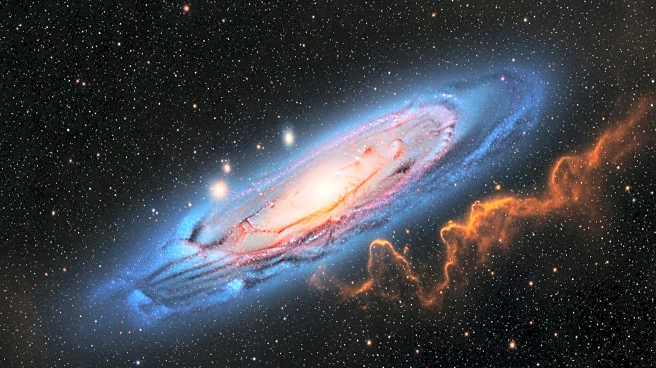
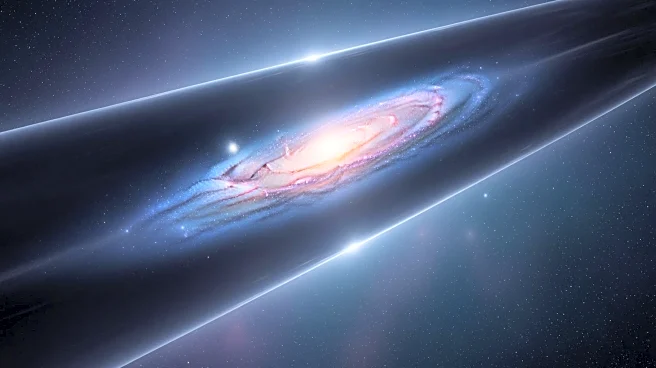
A new study has revealed that the Milky Way's nearest galactic neighbor, Andromeda, is moving towards it due to a vast, flat sheet of dark matter. This sheet is drawing galaxies into deep space, explaining why Andromeda is on a collision course with the Milky Way while
other galaxies are moving away. The gravitational pull from this dark matter sheet, which lies beyond the bounds of Andromeda and the Milky Way, overwhelms the attraction between our galaxy and other neighboring galaxies. The study, published in Nature Astronomy, used simulations to model the interactions among dark matter, the Local Group, and receding galaxies, revealing a flat mass distribution that affects galactic motions.
Why It's Important?
Understanding the dynamics of dark matter and its influence on galactic movements is crucial for comprehending the structure and evolution of the universe. This discovery provides insights into the gravitational forces shaping our cosmic neighborhood and could refine models of the universe's expansion. The findings have implications for cosmology, as they reconcile experimental results with astronomical observations and the leading model of cosmology, lambda cold dark matter. This research enhances our understanding of the universe's large-scale structure and the role of dark matter in cosmic evolution.
What's Next?
Future simulations and observations could further elucidate the role of dark matter in shaping the universe. Researchers may explore additional structures and voids in the cosmos to validate the study's findings. The potential collision between the Milky Way and Andromeda, predicted to occur in billions of years, remains a subject of interest for astronomers. Continued research into dark matter and its effects on galactic dynamics could lead to new discoveries about the universe's composition and behavior.