
What's Happening?
Recent research conducted by Edward Bryant and Vincent Van Eylen has revealed that aging Sun-like stars may lose their closest planets as they evolve. The study, based on data from NASA's Transiting Exoplanet
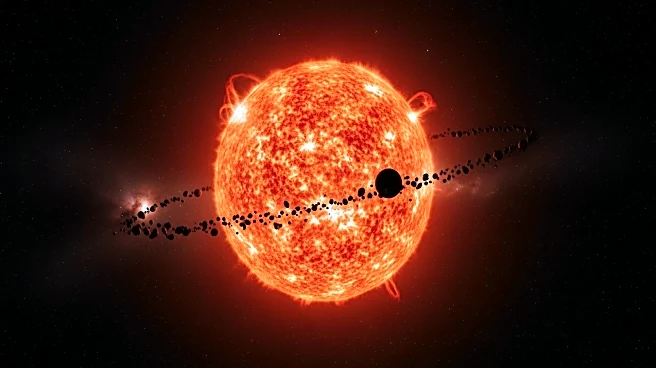
Survey Satellite (TESS), analyzed nearly 457,000 post-main-sequence stars and identified 130 planets and planet candidates in close orbits. The findings indicate that planets in short, close orbits are less common around older stars, suggesting that these planets are being destroyed as their host stars age. As stars expand, they can pull nearby planets inward through tidal forces or engulf them entirely, a process that becomes more pronounced as stars leave the main sequence.
Why It's Important?
This research provides valuable insights into the long-term evolution of planetary systems, particularly those similar to our own solar system. Understanding how stars and planets interact as stars age can help scientists predict the future of our solar system and others. The study also highlights the challenges of detecting planets around older stars, as larger stars produce weaker transit signals. These findings could influence future astronomical research and missions, such as the European Space Agency's upcoming Plato mission, which aims to further investigate the disappearance of planets around aging stars.
What's Next?
The study's findings open new avenues for research into the interactions between stars and their planets. Future missions, like the European Space Agency's Plato mission scheduled for 2026, will provide additional data to help scientists understand the mechanisms behind planetary loss in aging star systems. Researchers will continue to explore the role of stellar mass and metallicity in planetary formation and evolution, potentially leading to new models and theories about the life cycles of stars and their planetary companions.