




What's Happening?
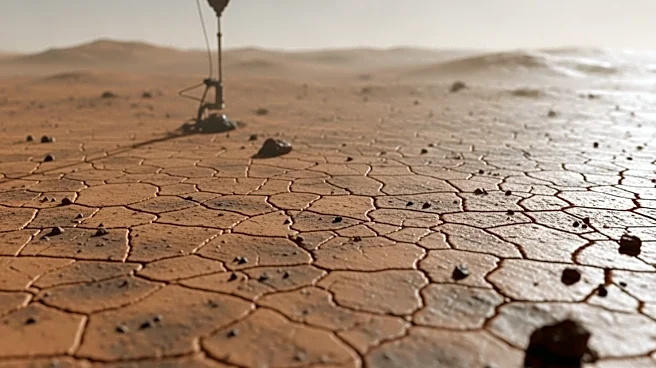
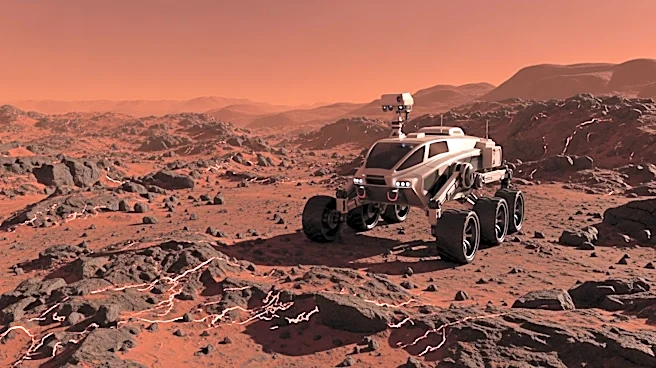
The Orpheus mission, presented by Connor Bunn and Pascal Lee of the SETI Institute, aims to explore Mars' volcanic regions using a Vertical Take-Off and Landing (VTOL) hopper. This innovative approach will allow the mission to access areas that traditional
rovers cannot reach, such as steep volcanic craters and deep pits. The mission will focus on the Cerberus Fossae region, known for its young volcanic features, which may harbor conditions suitable for life. Equipped with advanced scientific instruments, Orpheus will analyze soil and rock compositions, search for biosignatures, and investigate the geology of these regions.
Why It's Important?
The Orpheus mission represents a significant advancement in Mars exploration, offering a new method to investigate the planet's subsurface for signs of life. By targeting volcanic regions, the mission could uncover evidence of past or present microbial life, providing insights into Mars' habitability. The mission's success could redefine our understanding of life beyond Earth and influence future exploration strategies. Additionally, the use of VTOL technology demonstrates the potential for more versatile and efficient exploration of challenging terrains on Mars and other celestial bodies.
What's Next?
As the Orpheus mission progresses, scientists will focus on analyzing data collected from the volcanic regions to identify potential biosignatures. The mission's findings could lead to further exploration of Mars' subsurface, potentially involving more advanced technologies and international collaboration. The results may also inform the design of future missions aimed at directly sampling Martian soil and rock for definitive evidence of life. The scientific community will likely continue to refine exploration techniques and technologies to enhance the search for life on Mars and other planets.
Beyond the Headlines
The Orpheus mission highlights the importance of interdisciplinary collaboration in space exploration, combining expertise in engineering, geology, and astrobiology. It also underscores the ethical considerations of exploring other planets, such as the potential for contamination and the preservation of extraterrestrial environments. The mission may inspire public interest in space exploration and the search for life, influencing educational initiatives and funding priorities. As humanity continues to explore the cosmos, these discussions will play a crucial role in shaping the future of space exploration.