

What's Happening?
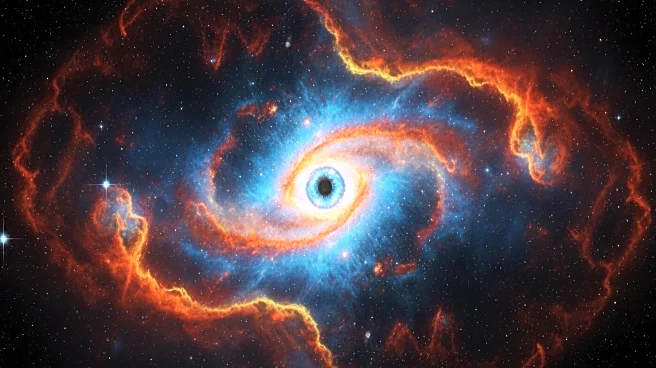
The James Webb Space Telescope, a collaborative project by NASA, ESA, and CSA, has captured a highly detailed image of the Helix Nebula, providing new insights into the final stages of a star's life. The image, taken on January 20, 2026, reveals intricate
structures such as comet-like knots and the effects of powerful stellar winds on the nebula's expanding shell of gas. The telescope's infrared capabilities have highlighted significant temperature shifts as material is ejected from the central white dwarf, allowing scientists to study the interaction between the dying star and its environment. This observation offers crucial clues to the lifecycle of stars and the formation of planetary nebulae.
Why It's Important?
The detailed observations from the James Webb Space Telescope are significant for advancing our understanding of stellar evolution. By mapping the temperature distribution within the Helix Nebula with unprecedented accuracy, researchers can better understand how dying stars disperse material into interstellar space. This knowledge is essential for comprehending the eventual fate of stars similar to our Sun and the processes that lead to the creation of planetary nebulae. The findings could have broader implications for astrophysics, potentially influencing theories about the lifecycle of stars and the dynamics of stellar environments.
What's Next?
Future observations by the James Webb Space Telescope are expected to continue providing high-resolution data on other celestial phenomena, furthering our understanding of the universe. Scientists will likely use these insights to refine models of stellar evolution and the formation of nebulae. The ongoing analysis of the Helix Nebula and similar structures could lead to new discoveries about the processes governing the end stages of stellar life and the distribution of elements in the cosmos.
Beyond the Headlines
The ability to observe the Helix Nebula in such detail also highlights the technological advancements achieved with the James Webb Space Telescope. Its infrared capabilities allow for the detection of thermal gradients and structural details that were previously obscured. This technological leap not only enhances our understanding of specific astronomical phenomena but also sets a new standard for future space telescopes and observational techniques.