





What's Happening?
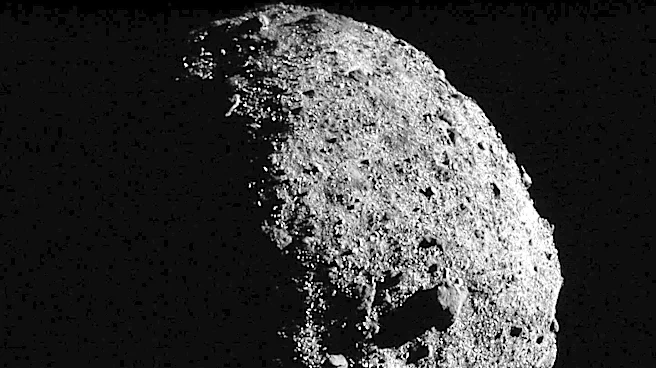
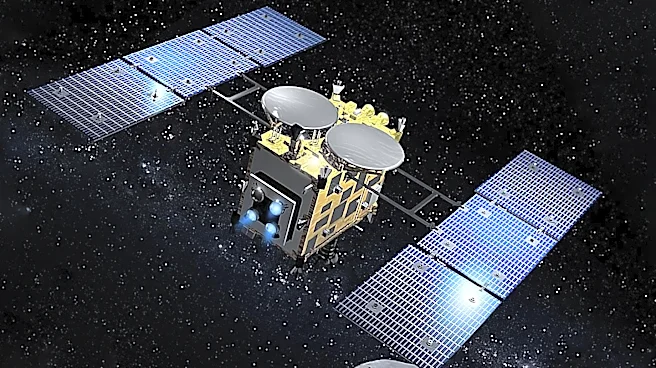
Over the July 4th weekend, two space missions from Japan and China made significant advancements in asteroid exploration. The Japanese Aerospace Exploration Agency's (JAXA) Hayabusa2 spacecraft conducted a flyby of asteroid 98943 Torifune. This maneuver,
executed at a speed of 5 km/s and a distance of 1 km, aimed to enhance space navigation technology for potential future planetary defense applications. Meanwhile, China's Tianwen-2 mission reached asteroid 469219 Kamoʻoalewa, a small near-Earth object. The mission plans to study and map the asteroid, collect samples, and return them to Earth by November 2027. These missions highlight ongoing international efforts in space exploration and the scientific study of asteroids.
Why It's Important?
These missions underscore the growing international interest in asteroid exploration, which has significant implications for scientific research and planetary defense. By studying asteroids, scientists can gain insights into the early solar system and the formation of planets. The data collected can also inform strategies for deflecting potentially hazardous asteroids, enhancing Earth's planetary defense capabilities. Furthermore, these missions demonstrate the technological advancements and capabilities of space agencies like JAXA and the China National Space Administration, potentially influencing global space policy and collaboration. The success of these missions could lead to increased investment in space exploration and technology development.
What's Next?
Following the successful flyby, Hayabusa2 is set to rendezvous with asteroid 1998 KY26 in 2031, continuing its mission of asteroid exploration. The Tianwen-2 mission will focus on collecting and returning samples from Kamoʻoalewa, with plans to rendezvous with the main-belt comet 311P/PanSTARRS in January 2035. These missions will likely contribute to a deeper understanding of asteroids and their potential resources, influencing future space exploration strategies. The outcomes may also impact international collaboration in space exploration, as countries seek to share data and resources for mutual benefit.