






What's Happening?
Public sentiment toward Artificial Intelligence (AI) appears to be entering a downturn, following a typical technology hype cycle. A 2026 Gallup poll indicates that U.S. members of Gen Z (18-29-year-olds), despite having the highest adoption rate of AI,
feel less hopeful and excited about the technology compared to a year ago. This shift is also reflected in public reactions, such as former Google CEO Eric Schmidt being booed at the University of Arizona in May 2026 when mentioning AI. Furthermore, the Merriam-Webster 2025 word of the year, 'slop,' describes low-quality or incredible AI-generated content, highlighting growing disaffection. While AI developers and researchers generally hold positive perceptions, a 2025 Pew poll found only 17% of the American public shares this view, indicating a polarized sentiment.
Why It's Important?
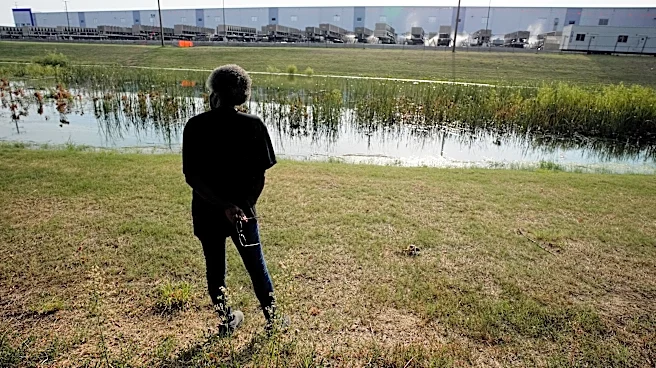
This evolving public sentiment has significant implications for the U.S. technology industry, policymakers, and society at large. A decline in public trust and excitement could lead to increased regulatory scrutiny, slower adoption rates for new AI products, and potential resistance to AI integration in various sectors. The bipartisan opposition to data center construction, with over $130 billion in projects blocked or delayed in early 2026 due to local resistance, underscores tangible public concerns about AI infrastructure. These concerns often revolve around resource consumption (water, electricity) and perceived economic inequality. This shift could influence investment in AI, push companies to prioritize ethical AI development, and necessitate greater transparency and public education efforts to rebuild trust and manage expectations.
What's Next?
The growing public disaffection suggests that AI developers and policymakers will need to address concerns more directly. Senator Bernie Sanders' proposal of the Sovereign Wealth Fund Act, which aims to tax AI companies and share profits with the public, indicates a potential legislative response to economic inequality concerns. Efforts to improve AI literacy are multiplying, spanning formal education, workplace training, and public resources, which will be crucial in shaping future public perception. However, research shows that news outlets primarily quote industry experts, leading to an 'industry-led debate' that may not fully address public concerns. Future developments will likely involve a greater emphasis on ethical AI frameworks, transparent communication about AI's benefits and risks, and a broader inclusion of diverse voices in the public discourse surrounding AI.
Beyond the Headlines
Beyond immediate economic and policy impacts, the shift in AI sentiment touches upon deeper societal and cultural dimensions. The term 'slop' for AI-generated content reflects a growing concern about authenticity and quality in the digital age, potentially leading to a re-evaluation of human creativity versus machine output. The polarization of views between AI experts and the general public highlights a communication gap that could exacerbate mistrust if not addressed. This situation also brings to the forefront questions about who controls the narrative around AI and whose voices are amplified. The resistance to data centers, seen as a 'physical manifestation of AI,' symbolizes a broader pushback against the unchecked expansion of technology and its environmental and social costs, suggesting a potential long-term shift towards more localized and community-centric technology development and deployment.