
What's Happening?
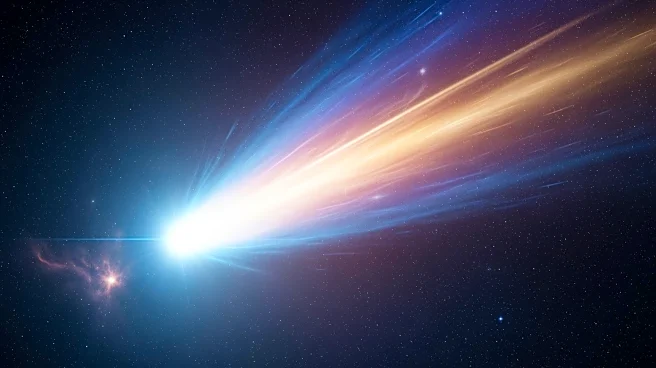
Comet 3I/ATLAS, an interstellar object, is approaching Earth, providing astronomers with a unique opportunity to study its characteristics. This comet, originating from outside our solar system, is the
third such object discovered, following 1I/'Oumuamua and 2I/Borisov. As it nears Earth on December 19, astronomers will be able to observe it more closely using telescopes, potentially revealing new information about the conditions in which it formed. The comet is believed to have been ejected from its original star system by a gravitational interaction with a giant exoplanet. Observations have already indicated that 3I/ATLAS is enriched in carbon dioxide, suggesting it formed much farther from its star than typical solar system comets.
Why It's Important?
The close approach of 3I/ATLAS offers a rare chance to study an interstellar object in detail, which could enhance our understanding of planetary formation processes in other star systems. By analyzing the comet's composition, scientists can infer the environmental conditions of its origin, providing a comparative framework against our solar system. This could lead to insights into the diversity of planetary systems and the potential for similar processes occurring elsewhere in the galaxy. The findings may also challenge or confirm existing theories about the uniqueness of our solar system's formation history.
What's Next?
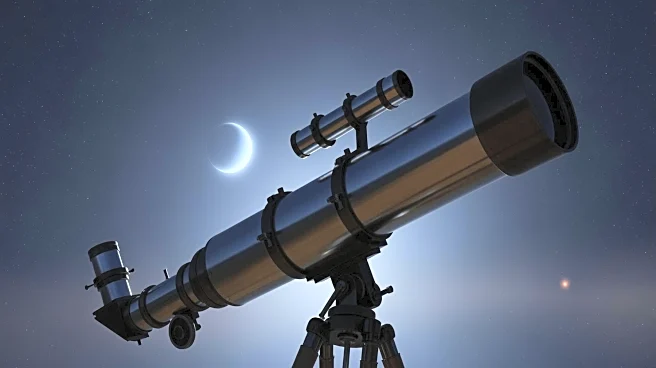
As 3I/ATLAS reaches its closest point to Earth, astronomers will intensify their observations using various telescopic facilities, including the James Webb Space Telescope. These observations aim to capture detailed data on the comet's composition and behavior. The scientific community anticipates that the data collected will contribute to ongoing research into interstellar objects and their role in the broader context of cosmic evolution. Public interest is also expected to rise, with amateur astronomers encouraged to observe the comet using powerful telescopes.
Beyond the Headlines
The study of 3I/ATLAS could have broader implications for our understanding of the Milky Way's history and the movement of celestial bodies within it. The comet's journey through the galaxy may provide clues about the dynamics of interstellar space and the potential for similar objects to impact planetary systems, including our own. This research could also inform future missions aimed at exploring or capturing interstellar objects for more direct study.