


What's Happening?
NASA has developed a new compact instrument, known as the Relativistic Electron Atmospheric Loss (REAL) instrument, designed to measure high-energy particles in the near-Earth space environment. This instrument is part of the REAL CubeSat mission and
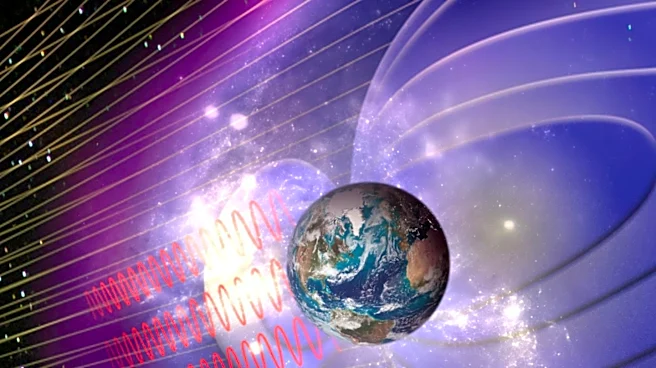
aims to provide more comprehensive measurements of how energetic particles are transported and lost in Earth's radiation environment. The Van Allen radiation belts, which consist of high-energy charged particles, pose significant risks to satellites that are crucial for modern society, such as those providing GPS and communication services. The REAL instrument, successfully launched on July 23, 2025, is equipped with miniaturized sensors that allow it to capture data on energetic electron precipitation (EEP) events, which are key to understanding the dynamics of these radiation belts.
Why It's Important?
The development of the REAL instrument represents a significant advancement in space weather research, particularly in understanding the behavior of the Van Allen radiation belts. These belts can cause operational anomalies in satellites, which are vital for communication, navigation, and other services. By providing detailed measurements of electron precipitation events, the REAL instrument helps scientists predict and mitigate the effects of space weather on satellite operations. This capability is crucial for maintaining the reliability of space-based systems that modern society heavily relies on. Furthermore, the success of the REAL instrument demonstrates that complex measurements can now be achieved with smaller, cost-effective instruments, paving the way for future CubeSat missions that could continuously monitor Earth's radiation environment.
What's Next?
The REAL instrument continues to collect valuable data, and its team is working on fine-tuning its sensitivity to improve its performance. The insights gained from this mission could lead to the development of CubeSat constellations capable of providing continuous observations of Earth's radiation environment. Such advancements would enhance our ability to protect space-based systems from the adverse effects of space weather. Additionally, the success of the REAL mission may inspire further innovations in miniaturized sensor technology, enabling more complex and cost-effective space missions in the future.