

What's Happening?
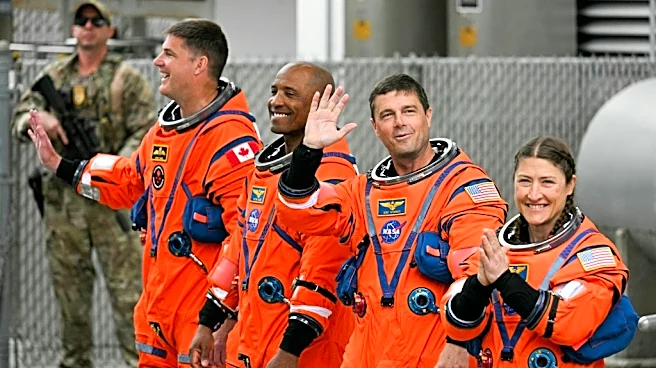
NASA has launched the Artemis II mission, marking the first time since 1972 that astronauts are being sent toward the moon. The mission includes four astronauts—three Americans and one Canadian—who will perform a close lunar flyby without landing. The crew,
led by mission commander Reid Wiseman, will pass within 6,500 kilometers of the lunar surface. This mission is part of NASA's Artemis program, which aims to establish regular missions to the moon and eventually land astronauts on the lunar surface by 2028. The program has been a significant investment for the U.S., costing at least $93 billion since 2012.
Why It's Important?
The Artemis II mission represents a significant milestone in space exploration, as it revives human spaceflight beyond low Earth orbit for the first time in over five decades. This mission is crucial for testing the capabilities of NASA's new space systems and for paving the way for future lunar landings. The involvement of international astronauts, such as Canadian Jeremy Hansen, highlights the collaborative nature of modern space exploration. The mission's success could bolster U.S. leadership in space and inspire advancements in technology and science, with potential benefits for various industries.