



What's Happening?
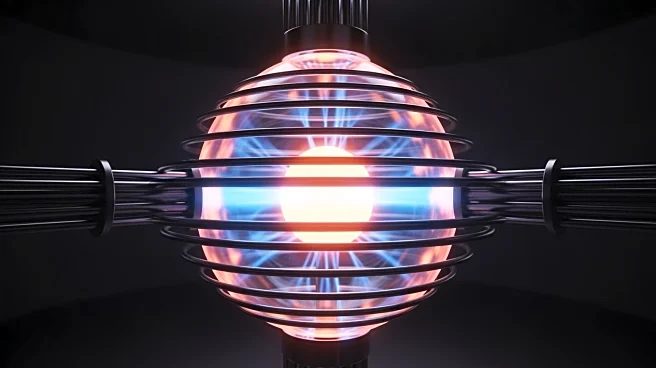
Scientists working with China's Experimental Advanced Superconducting Tokamak (EAST) have achieved a significant breakthrough in fusion technology by reaching a 'density-free regime' in fusion plasma experiments. This state allows the plasma to remain
stable even at high densities, overcoming a major barrier in fusion research. The findings, published in Science Advances, challenge long-standing assumptions about plasma behavior and offer new insights into achieving fusion ignition.
Why It's Important?
This breakthrough in fusion technology represents a major step forward in the pursuit of clean and sustainable energy. By overcoming the density limits that have constrained fusion experiments, scientists are closer to achieving fusion ignition, which could revolutionize energy production. The development has significant implications for global energy strategies, potentially reducing reliance on fossil fuels and contributing to efforts to combat climate change.
What's Next?
The research team plans to apply the new high-density operating approach during high-confinement operations on EAST, aiming to achieve the density-free regime under high-performance plasma conditions. This next phase of experimentation could further validate the findings and bring scientists closer to practical applications of fusion energy. The continued success of these experiments could accelerate the development of fusion reactors and influence future energy policies worldwide.