






What's Happening?
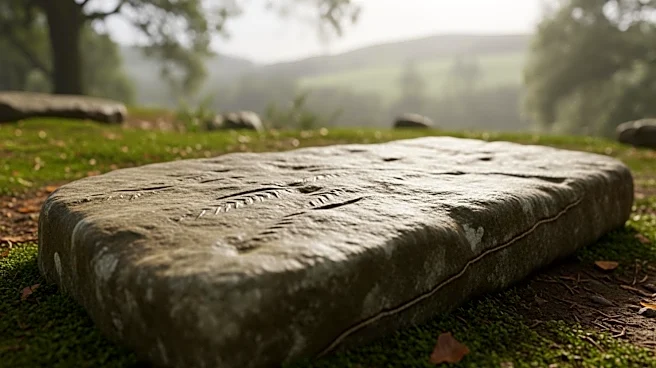
A recent study led by researchers at Curtin University has provided new insights into the transportation of the Altar Stone, a six-ton sandstone megalith at the center of Stonehenge. The study suggests that ancient humans, rather than natural forces,
were responsible for moving the stone from its origin in northeast Scotland to its current location on Salisbury Plain, a distance of approximately 700 kilometers. Previous theories posited that glaciers might have transported the stone part of the way during the last Ice Age. However, the study's findings, which involved mineral grain dating and computer modeling of ancient ice sheets, indicate that no viable glacial route could have delivered the stone directly to southern England. This suggests that the stone's movement was a deliberate and carefully planned human endeavor, likely involving a combination of overland hauling and river or coastal transport.
Why It's Important?
The study's findings highlight the remarkable organizational capabilities of Neolithic communities, suggesting a level of planning and cooperation that was previously underestimated. The transportation of such a massive stone over a vast distance would have required significant coordination among different groups and a deep understanding of the landscape. This discovery not only sheds light on the construction of Stonehenge but also provides a broader understanding of the social and cultural dynamics of prehistoric Europe. The research underscores the ingenuity and determination of ancient peoples, challenging previous assumptions about their capabilities and the complexity of their societies.
What's Next?
Researchers plan to continue their investigation into the Altar Stone's origins by pinpointing its precise source location in northeast Scotland. They aim to explore the potential routes that prehistoric people may have used to transport the stone. This ongoing research could further illuminate the methods and strategies employed by ancient communities in constructing Stonehenge, offering deeper insights into their technological and logistical prowess.