
What's Happening?
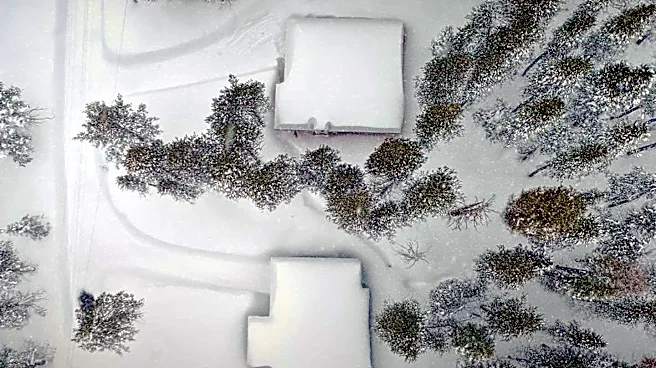
Billy Barr, residing in a remote area of Colorado's Gunnison National Forest, has spent 52 winters meticulously recording daily snowfall, temperature, and weather observations. His records, initiated in 1974,
have become a crucial climate dataset for researchers. Barr's data, collected from his off-grid cabin near the Rocky Mountain Biological Laboratory, provides a continuous climate record that aids in calibrating satellite snow measurements and understanding groundwater flows in the Colorado River Basin. This dataset is invaluable for scientists studying various ecological phenomena, offering a baseline for interpreting environmental changes.
Why It's Important?
Barr's extensive data collection offers a rare, unbroken insight into climate patterns over decades, crucial for understanding long-term environmental changes. His records help calibrate modern remote sensing technologies, ensuring accuracy in climate models. The data supports research on ecological shifts, such as phenological mismatches between species, highlighting the broader impacts of climate change. Barr's work underscores the importance of long-term, consistent data collection in environmental science, providing a foundation for future research and policy-making in climate adaptation and water resource management.
What's Next?
As Barr ages, the continuity of this valuable dataset is uncertain. The scientific community faces the challenge of maintaining such long-term data collection efforts, which are often underfunded. Discussions around institutional support and funding for ongoing environmental monitoring are crucial to ensure the continuation of this work. The potential cessation of Barr's data collection raises questions about the sustainability of volunteer-driven scientific contributions and the need for structured support to preserve these critical environmental records.