




What's Happening?
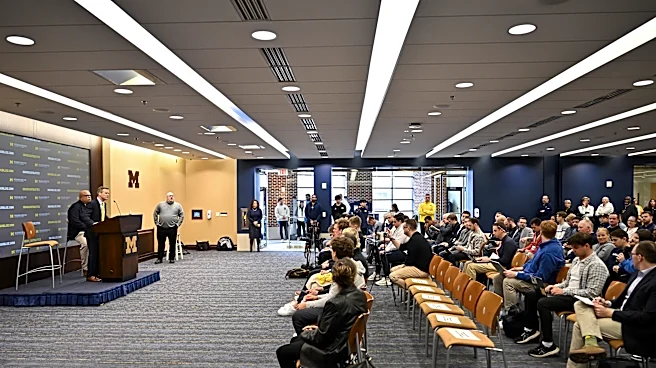
The University of Michigan recently hosted an 'Ann Arbor Ed Talk' as part of the Life-Changing Education initiative, focusing on the contemporary relevance and value of higher education. The event featured a panel of three speakers: Michael Bastedo, education professor
and senior associate dean for research and graduate affairs; Mika LaVaque-Manty, associate professor of political science; and Jeremy Wright-Kim, assistant professor of education. The discussion covered various topics, including the cost of higher education, accessibility, the economic returns of a college degree, and the potential impact of artificial intelligence on learning and teaching. Michael Bastedo highlighted that flagship universities often provide more financial resources to lower-income students, making attendance potentially less expensive for them compared to regional campuses. Jeremy Wright-Kim emphasized the significant lifetime earnings advantage for those with a bachelor's degree, while also stressing the importance of informing the public about available financial aid. Mika LaVaque-Manty introduced the challenge posed by AI, noting its potential to threaten traditional learning and its cost-effectiveness compared to expensive college tuition.
Why It's Important?
This discussion is important as it addresses critical questions facing prospective students, current students, and policymakers regarding the increasing cost and perceived value of a college education in the U.S. The insights shared by the panelists shed light on the complex financial landscape of higher education, particularly how costs can vary significantly based on income levels and institutional resources. The emphasis on financial aid accessibility and the underutilization of available funds highlights a systemic issue that could prevent deserving students from pursuing higher education. Furthermore, the conversation about artificial intelligence's role in education signals a looming transformation in pedagogical methods and skill development, prompting institutions to adapt their curricula to remain relevant. Understanding these dynamics is crucial for ensuring equitable access to education and preparing the future workforce for an evolving technological landscape.
What's Next?
The 'Ann Arbor Ed Talk' is the first in a series of community conversations planned by the Life-Changing Education initiative, aiming to foster broader discourse beyond academic circles. Future talks are expected to continue exploring the evolving landscape of education, potentially delving deeper into the implications of AI, strategies for improving college affordability, and innovative approaches to learning. Policymakers and educational institutions may use insights from these discussions to re-evaluate financial aid policies, develop more effective outreach programs for prospective students, and integrate new technologies like AI into educational frameworks responsibly. The ongoing dialogue could also influence how universities market themselves and justify their value proposition in an increasingly skeptical public environment, especially concerning tuition costs versus career outcomes.
Beyond the Headlines
Beyond the immediate discussion, the 'Is college still worth it?' question touches upon deeper societal and economic shifts. The panel's points about financial aid underscore a broader issue of information asymmetry and administrative hurdles that disproportionately affect lower-income families. The rise of AI also presents an ethical dilemma for educators: how to leverage technology for efficiency without compromising critical thinking, creativity, and human interaction in learning. This conversation implicitly challenges the traditional model of higher education, suggesting a need for greater transparency in pricing, more robust support systems for diverse student populations, and a proactive approach to integrating technological advancements. The long-term implications could include a redefinition of what constitutes a 'valuable' degree and a push towards more flexible, skills-based learning pathways that compete with or complement traditional four-year programs.