





What's Happening?
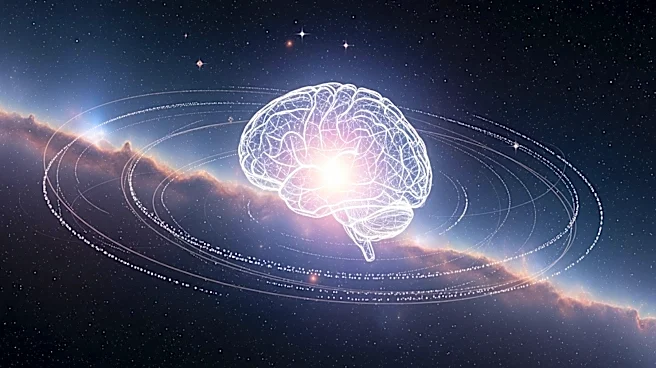
A recent study by SFI Professor David Wolpert, SFI Fractal Faculty member Carlo Rovelli, and physicist Jordan Scharnhorst explores the Boltzmann brain hypothesis, a concept in physics and cosmology. This hypothesis suggests that our memories and perceptions
might not reflect a real past but could instead be random formations due to entropy fluctuations. The study examines the tension within statistical physics, particularly Boltzmann's H theorem, which is time-symmetric and does not inherently prefer one direction of time over another. This leads to the possibility that our memories could be illusions rather than reliable records. The researchers developed a formal framework to analyze how different assumptions about time and entropy affect conclusions about memory reliability.
Why It's Important?
The implications of the Boltzmann brain hypothesis challenge fundamental understandings of time, memory, and reality. If our memories are not reliable, this could have profound effects on how we perceive history and make decisions based on past experiences. The study highlights the potential for circular reasoning in arguments about entropy and memory, where assumptions about the past are used to justify conclusions that, in turn, support those assumptions. This research encourages a reevaluation of how physical laws are interpreted and the assumptions underlying our understanding of time and memory. Such insights could influence fields ranging from physics to philosophy, impacting how scientific theories are developed and understood.
What's Next?
The study does not resolve the debate but aims to clarify the underlying structures of arguments about entropy and memory. By distinguishing between physical laws and interpretative assumptions, the researchers provide a framework for more transparent discussions on these topics. Future research may focus on further exploring the implications of the Boltzmann brain hypothesis and its impact on our understanding of the universe. This could lead to new theoretical developments in physics and cosmology, as well as philosophical inquiries into the nature of reality and consciousness.
Beyond the Headlines
The Boltzmann brain hypothesis raises ethical and philosophical questions about the nature of reality and human experience. If our memories are potentially unreliable, this challenges the basis of personal identity and historical knowledge. The study's findings could influence debates on free will, determinism, and the nature of consciousness. Additionally, the research underscores the importance of critically examining the assumptions that underpin scientific theories, which could lead to more robust and comprehensive models of understanding the universe.