
What's Happening?
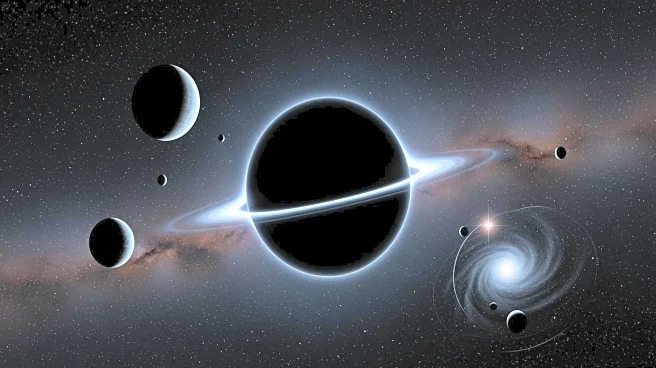
A recent study proposes that some objects previously identified as exoplanets might actually be primordial black holes. These black holes, hypothesized to have formed shortly after the Big Bang, could
have masses similar to planets but are much smaller in size. The study, which has not yet been peer-reviewed, suggests that the gravitational effects observed in some exoplanet detections could be attributed to these black holes rather than planets. This hypothesis challenges current methods of exoplanet detection, which often rely on observing the gravitational 'wobble' of stars caused by orbiting bodies.
Why It's Important?
If confirmed, this hypothesis could significantly alter our understanding of the universe's early conditions and the formation of celestial bodies. It would suggest that primordial black holes are more common than previously thought, potentially offering new insights into the distribution of matter in the universe. For astronomers, this could mean revisiting existing exoplanet data to differentiate between planets and black holes, impacting the search for habitable worlds. The study highlights the need for advanced observational techniques to accurately identify and characterize distant celestial objects.