






What's Happening?
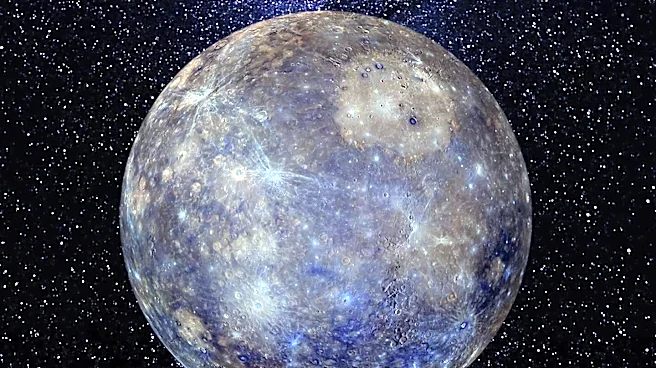
Mercury is becoming increasingly visible in the early morning sky, brightening to a magnitude of 0.5. It is positioned roughly 4 degrees above the eastern horizon before sunrise, making it easier to spot. This visibility is expected to improve as Mercury approaches
its greatest western elongation. Observers can also see Mercury aligned with two faint stars in Gemini, Delta and Lambda Geminorum, although these stars will quickly fade in the morning twilight. The best time to view Mercury is about an hour before sunrise, and it is recommended to use a telescope for a closer look at its crescent shape.
Why It's Important?
The visibility of Mercury provides a unique opportunity for both amateur and professional astronomers to observe one of the solar system's innermost planets. As Mercury approaches its greatest western elongation, it offers a rare chance to study its surface and atmospheric conditions. This event also serves as an educational moment for the public, encouraging interest in planetary observation and the dynamics of our solar system. The alignment with stars in Gemini adds an additional layer of interest for skywatchers.
What's Next?
As Mercury continues to brighten and approach its greatest western elongation, observers are encouraged to take advantage of the clear morning skies to view the planet. This period of visibility will last for several days, providing ample opportunity for observation and photography. Following this event, Mercury will gradually become less visible as it moves closer to the sun, transitioning into the evening sky.