
What's Happening?
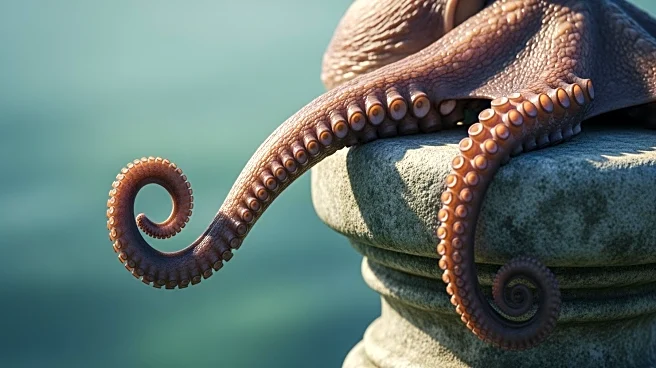
Professor Tim Coulson from the University of Oxford has proposed that octopuses could potentially replace humans as Earth's dominant species if humans were to become extinct. In his book, 'The Universal
History of Us,' Coulson explores the concept of evolution and natural selection, suggesting that octopuses, with their advanced neural structures and problem-solving abilities, could evolve into a civilization-building species. He highlights their adaptability and intelligence, which could allow them to thrive in a post-human world, despite challenges such as adapting to life on land.
Why It's Important?
This hypothesis challenges traditional views on evolution and the future of life on Earth, prompting discussions about biodiversity and the resilience of different species. Coulson's theory underscores the importance of understanding evolutionary processes and the potential for unexpected developments in the natural world. It also raises awareness about the impact of human activities on ecosystems and the possibility of other species rising to prominence if humans were to disappear. This perspective encourages a broader consideration of conservation efforts and the need to protect diverse life forms that could play significant roles in Earth's future.
Beyond the Headlines
Coulson's proposal invites reflection on the ethical and philosophical implications of human dominance and our responsibility towards other species. It highlights the interconnectedness of life on Earth and the potential for significant ecological shifts in the absence of humans. This thought experiment serves as a reminder of the transient nature of species dominance and the ongoing evolution of life, encouraging a reevaluation of humanity's place within the broader ecological context.