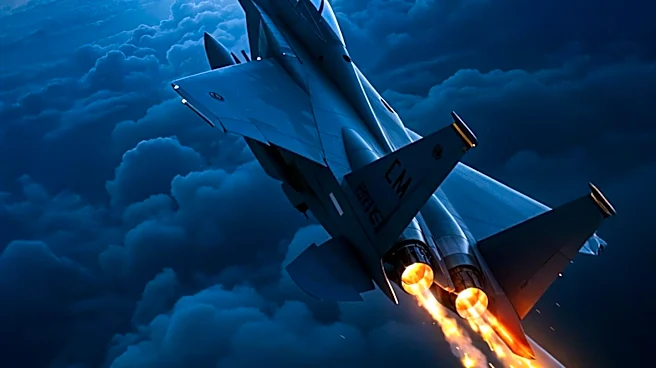

What's Happening?
The SR-71 Blackbird, an advanced strategic reconnaissance aircraft, consistently demonstrated its superior stealth and speed during operational lifetime and training exercises, making it exceptionally
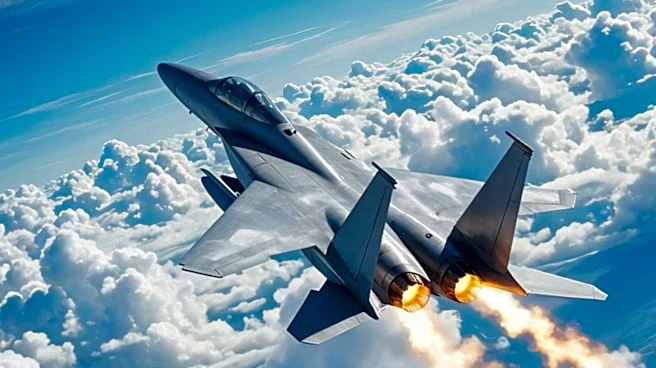
difficult for other fighter jets to track. During 'Eagle Bait' sorties, where SR-71s provided practice targets for U.S. Air Force F-15s, the F-15s often failed to detect the Blackbird, even when its defensive countermeasures were off and its location was known. According to former SR-71 pilot Dave Peters, a key reason for this was a speed gate on the F-15's radar, which was capped at 1500 knots. Since the SR-71 routinely flew at speeds between 1850 to 2000 knots, it simply did not register on the F-15's radar. This technological limitation meant that for the F-15s, the SR-71 effectively 'didn't exist' during these high-speed intercepts over areas like the Nellis AFB training area.
Why It's Important?
The operational history of the SR-71 Blackbird, particularly its performance against contemporary fighter aircraft like the F-15, underscores the critical role of advanced reconnaissance technology in national defense. The Blackbird's ability to evade detection, even under controlled training conditions, highlighted a significant technological gap that could have profound implications in real-world combat scenarios. This demonstrated superiority in speed and stealth provided the U.S. with an unparalleled intelligence gathering capability, allowing it to conduct reconnaissance missions over hostile territories with minimal risk of interception. The 'Eagle Bait' exercises revealed that even the most advanced U.S. fighter jets of the era had limitations in engaging such high-performance targets, emphasizing the continuous need for innovation in radar and aircraft design to counter evolving threats. This historical context remains relevant for understanding the ongoing arms race in military aviation and the strategic importance of maintaining technological superiority.
What's Next?
While the SR-71 Blackbird was retired from active service in 1990, its legacy continues to influence modern aerospace engineering and military strategy. The lessons learned from its operational challenges, such as the F-15's radar limitations, have likely informed the development of subsequent generations of stealth aircraft and advanced radar systems. Future advancements in aerial reconnaissance and combat will continue to focus on overcoming such technological hurdles, pushing the boundaries of speed, stealth, and detection capabilities. The ongoing development of hypersonic aircraft and advanced sensor technologies suggests a continued pursuit of the kind of strategic advantage once held by the Blackbird. The historical data from these exercises also serves as a valuable reference for understanding the complexities of air combat and the interplay between offensive and defensive aviation technologies.
Beyond the Headlines
The story of the SR-71 Blackbird and its evasion of F-15 radar goes beyond mere technical specifications; it illustrates a fundamental principle in military technology: the constant interplay between offense and defense. The Blackbird's design represented a pinnacle of offensive reconnaissance, pushing the limits of what was thought possible in terms of speed and altitude. The F-15's inability to track it, despite being a formidable fighter, highlights the inherent challenges in developing comprehensive defensive systems against cutting-edge threats. This dynamic fuels continuous innovation, driving significant investments in research and development within the defense industry. Ethically, the development of such advanced surveillance capabilities raises questions about privacy and the scope of intelligence gathering in an increasingly interconnected world. Culturally, the SR-71 has achieved an iconic status, symbolizing American ingenuity and technological prowess, influencing popular culture and inspiring future generations of engineers and aviators.