



What's Happening?
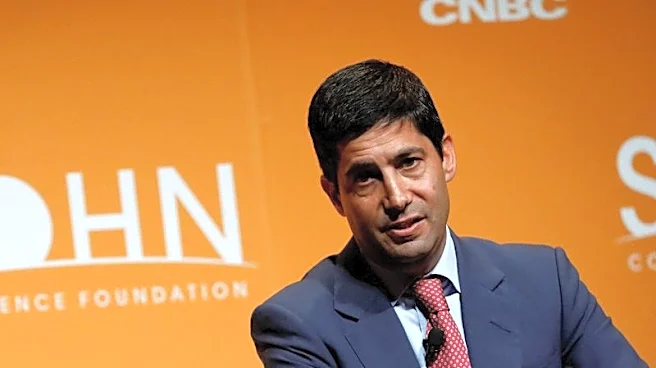
Kevin Warsh, a former Federal Reserve governor nominated by President Trump to lead the central bank, has filed financial disclosures indicating assets exceeding $100 million. The disclosure, necessary for his Senate confirmation, includes significant
investments such as over $50 million in the Juggernaut Fund LP and $10.2 million in consulting fees from Stanley Druckenmiller's investment office. Warsh has pledged to divest from these holdings if confirmed. The document, reviewed by the U.S. Office of Government Ethics, also lists various other assets, including interests in artificial intelligence and cryptocurrency sectors, though many values are undisclosed. Warsh's spouse, Jane Lauder, is also noted for her substantial family wealth linked to the Estee Lauder company. The Senate Banking Committee has yet to schedule a hearing for Warsh's confirmation, which is complicated by a DOJ investigation into current Fed Chair Jerome Powell, whose term ends on May 15.
Why It's Important?
Warsh's nomination and financial disclosures are significant as they highlight the intersection of personal wealth and public service, raising questions about potential conflicts of interest. His substantial assets and commitments to divest are crucial for compliance with the Ethics in Government Act. The confirmation process is further complicated by political dynamics, including a DOJ investigation into Powell, which could delay Warsh's confirmation. This situation underscores the complexities of leadership transitions at the Federal Reserve, an institution critical to U.S. monetary policy and economic stability. The outcome of Warsh's confirmation could influence future Fed policies, impacting financial markets and economic stakeholders.
What's Next?
The Senate Banking Committee must schedule a hearing for Warsh's confirmation, which could occur as early as next week. However, a key Republican lawmaker has vowed to block the confirmation until the DOJ investigation into Powell concludes. This political maneuvering could delay Warsh's confirmation, potentially affecting the leadership transition at the Fed. If Warsh is not confirmed by May 15, Powell may continue as Fed Chair on a temporary basis. The unfolding events will be closely watched by financial markets and policymakers, given the Fed's pivotal role in managing U.S. monetary policy.